Blame, accountability and responsibility
Introduction
Both at work and at home, I often find myself facing problems.
At work, these problems might come in the form of bugs, bad estimations, projects not going to plan and other day-to-day errors. They can be big, they can be small. They can originate from miscommunications or misunderstandings, simple human error, inefficiencies, personal situations affecting one's concentration, or a myriad of other potential causes.
The point is, problems exist. And they'll always exist. They're a part of life. Although, overcoming them actually often provides a great opportunity for us to grow, change and improve.
So the question is: How do we deal with them?
Well, I don't have one simple answer to that. So if you came here looking for a solution to all of your problems, I'm afraid you're out of luck. But that’s because there is no one solution for all problems. Silver bullets (sadly) don't exist.
But...
There is always attitude. And this is the next best thing to a silver bullet.
ATTITUDE? WHAT DO YOU MEAN BY THAT?
I'm a person who likes definitions. So before I speak of attitude, I'm going to give you a definition of it. According to Google, attitude is "a settled way of thinking or feeling about something". In other words (my words), it is the way we view a situation, and our disposition towards it. Attitudes can be positive or negative, depending on the perception we have of the thing in question. In this context, though, I'm referring to the way we face problems and the situations that can arise from them.
How does attitude help solve problems?
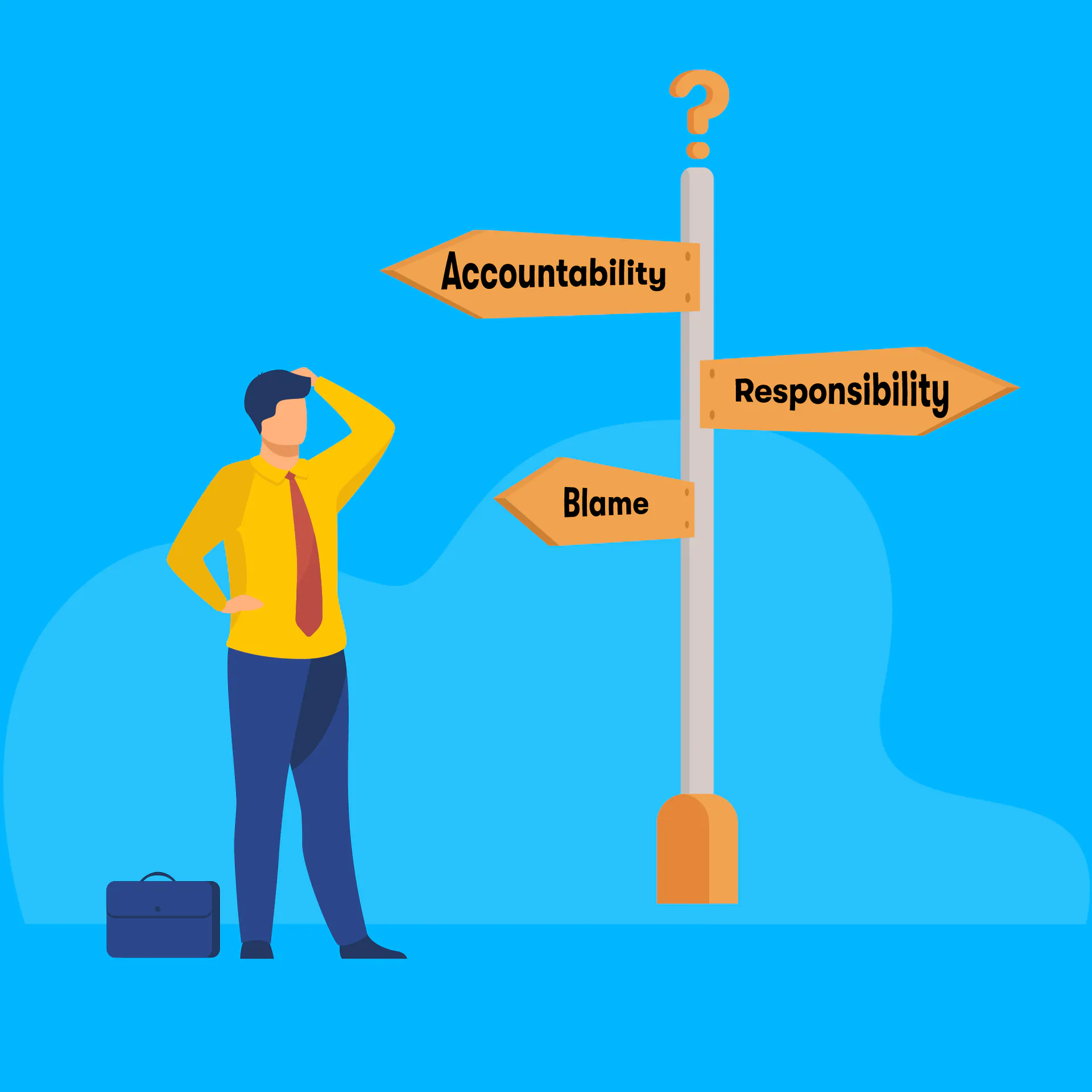
Whenever we face a problem, there are many ways we can act upon it. These “ways” reflect how we feel about the issue, and what we want to do about it. Of the myriad of attitudes people may have towards problems, I'm going to place the focus on three common ones: blame, accountability and responsibility.
Across my career (and life) I've found these to be three of the most common approaches to dealing with problems. And I've experienced all three of them myself. So, let’s look at each one in a bit more detail.
Blaming is worthless
The first of the three attitudes is the easiest one: blame.
Blame focuses on pointing out the origin of a problem. Which often leads us in the wrong direction. It confuses us, by making us look for the cause rather than the solution. Let’s take an example of a productive database being suddenly dropped. If we focus on the cause, we might find out that a junior dev was the one behind the drop, or that a DBA granted that junior dev the permissions to drop a productive database. But none of these facts help us solve the issue.
Deep down, no one wants to be blamed for things. Especially for something that we didn't do. So we also put effort into making sure we won’t be the ones blamed. And that complicates things, too. It becomes a game of passing the buck and blaming others, rather than taking ownership and dealing with fixing it. In the previous example, the DBA could blame his manager because he was told to grant those permissions, and the manager could blame the DBA because the DBA should have put a stop to an unsafe request. But where does that get us?
As you can no doubt already see, the most important thing (i.e. the solution) is to restore the database. So the focus should be on that, rather than on finding out who did what.
My take on blame is that it's useless. It gives a sense of justification and self-righteousness to people who weren’t involved in how the problem came about, but that serves no practical purpose. It is only a way to point out who should be held accountable for the problem, but it goes no way towards fixing or solving it.
Accountability is expensive
Many times I've heard people, especially managers, say that they expect people (generally referring to others) to be accountable for their actions; that they want people who can be held accountable, and so on. So, what exactly does accountability mean?
According to the Cambridge Dictionary, accountability is "the fact of being responsible for what you do and able to give a satisfactory reason for it, or the degree to which this happens". In short, it means that you need to answer for your crimes. When a problem arises that you were ultimately responsible for, then you are the one that has to put your hand up and admit that it was your wrongdoing, and ultimately either take the fall for it, and/or do something about it.
This is essentially the next step up from blame, and the reason why no one wants to take the blame for things. Because no one wants to be completely responsible for having to find a way to solve the issue. The problem with the accountability approach is that it's limited to our individual scope of responsibility and our individual actions.
For instance, in the previous example it would mean that the junior dev should restore the productive database, while the DBA should make sure that junior devs no longer have access to productive databases (actually, what they should do is make appropriate database permission schemas, but that's another topic). So in this case, it means the restoration of the database falls to the hands of the junior dev.
Now, this is simplifying things a little bit. The junior dev is part of a team that should contain a senior dev and some other sort of infrastructure to solve the problem. But the important point is that the DBA would only be accountable for his specific actions and is constrained by its scope.
In general, it is better to have accountability across a company, rather than on an individual level, which can just lead to people blaming each other. Holding someone individually accountable is limited by the fact that people will not answer for the entirety of a problem, but for what they think is their scope of work. And this doesn't solve the problem as a whole, only its parts.
Responsibility is free… and valuable
Now, this is the one I like (who would have thought it?). Let's start with the definition: Cambridge Dictionary defines it as "something that it is your job or duty to deal with".
Please take note that it doesn't say "solve the problem" but rather "deal with it".
Sometimes, we don't immediately have the solution, but we have to deal with the problem anyway – either by finding someone that does have the solution, or working to find it in another way. But irrespective of who or whatever caused it, and of whether we have the ability to fix it immediately, it doesn’t matter – it doesn't remove the responsibility from us.
The difference with accountability resides in the fact that this attitude is not constrained to the individual things we do, or have done. In the database drop example, the DBA would make sure that the table is restored to how it was, regardless of whose fault it was. The identified issues would be that the database has dropped and that there's an unauthorized person that has access to it, and everyone that can reasonably help to resolve these issues will do so. It is taking a more communal and team approach to things. In the end, this is beneficial to everyone.
Conclusion
Although accountability is generally said to be what we want, what we really need is to be taking responsibility. Not just for our own problems, but in general.
Accountability leads to blame, responsibility leads to solutions…
For our team, and for everything that is around us, both at work and outside of our work context, we need to take ownership of what we are doing in order to push forward. And I want and expect the people around me to have the same attitude.
Thankfully, at Hotovo I was able to find people with such a way of thinking, and we constantly push forward together to solve our problems and our customers’ problems – frequently going even beyond what is agreed in the contract. I haven’t dropped any productive databases (yet) but I feel secure that if such a thing were to happen, either to me or anyone in our scope of influence, everyone would be glad to jump in to help resolve it and add their support.

I am a leader of innovation and excellence, and the branch manager from the other side of the globe — Argentina. With an eye for engineering and a drive for success, I take on the challenge of steering our business into the future.