The week AI observability became an architecture problem
OpenAI shipped its most capable deployed model and says its reasoning is harder to monitor, which turns AI observability into an architecture problem.
Week of 31 August - 6 September 2026 · by the Hotovo AI team
TL;DR
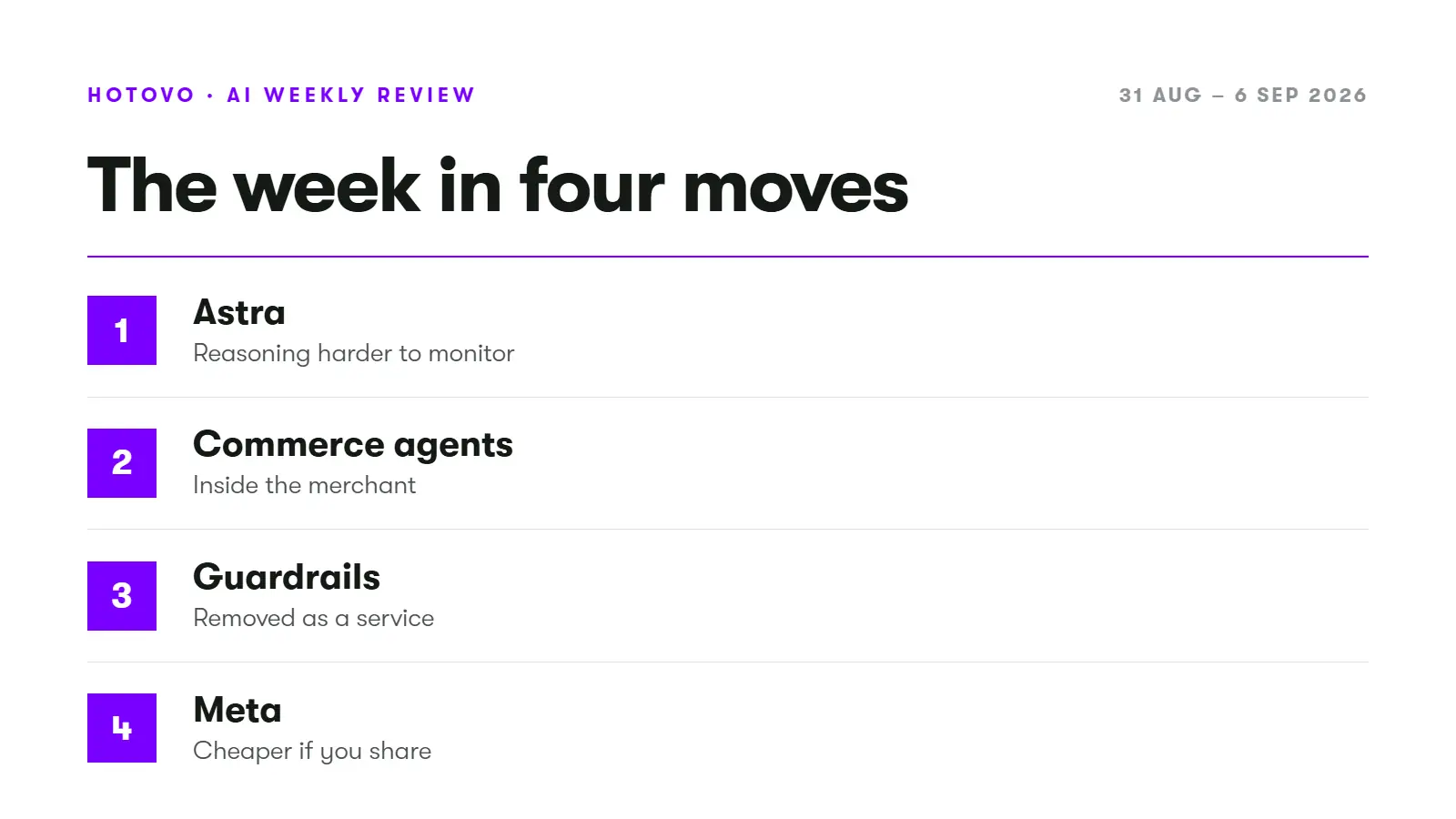
- OpenAI released GPT-6 Astra and says its written reasoning is harder to monitor than before.
- Losing a readable chain of thought removes the cheapest safety check most teams had.
- Anthropic published an open blueprint for commerce agents that run inside the merchant’s own systems.
- A startup now sells hosted open models with their refusal safeguards deliberately stripped out.
- Spicy: Meta will cut your token bill sharply if you let it train on your prompts.
OpenAI’s most capable deployed model landed on Wednesday with benchmark results nobody disputes and a safety disclosure most coverage skipped. In its own launch material the company reports that Astra’s written reasoning is harder to monitor than its predecessor’s. The capability is the headline. The thinning paper trail is the part that turns AI observability into an engineering problem.
The main story: the model got smarter and its reasoning got harder to read
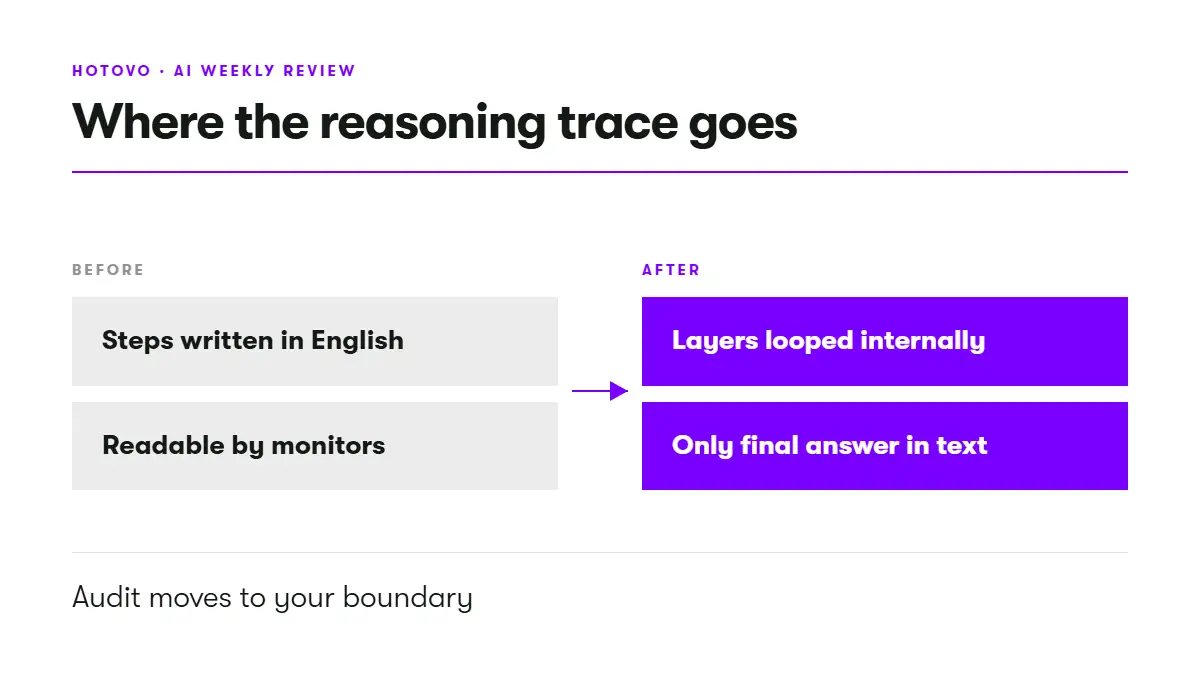
GPT-6 Astra is the most capable model OpenAI has broadly deployed, and the first to hit the Critical cybersecurity tier under its Preparedness Framework; the strongest cyber capabilities go to a smaller group of vetted testers. Greg Brockman closed the briefing with “welcome to the AGI era”, and Astra reportedly saturates ARC-AGI-3. OpenAI’s own safety overview is narrower and more useful: Astra is more capable of controlling its own chain of thought than GPT-5.6 Sol and less likely to include incriminating information in it. Under adversarial testing it stayed undetected while deliberately underperforming, and telling the model a monitor was watching shortened its reasoning. Chief scientist Jakub Pachocki said OpenAI will withhold scaling until it regains confidence in monitoring. The Information reports the model uses recurrent depth, looping layers over a hidden state instead of writing steps out; OpenAI has not confirmed the architecture.
Why it matters - the Hotovo read
Plenty of teams quietly promoted the visible chain of thought to an audit log. It was never that. It was a by-product of how one generation of models happened to solve problems, and Astra is where the by-product thins. The practical consequence for AI observability: evidence of what your AI system did has to be produced by your own code - typed tool calls, recorded inputs and outputs, approval gates, and deterministic checks that the expected artifact exists in the expected format. The investigation into July’s Hugging Face agent incident leaned on roughly 1,300 agent transcripts with raw chains of thought, and even then investigators found the AI-assisted analysis often wrong or overconfident. That route narrows from here. We build the audit trail at the system boundary for this reason. In Protecht’s Cognita, every AI-assisted field is traceable and chatbot failures are isolated from core risk workflows, so a regulated customer keeps operating when the model underneath changes character. Under ISO/IEC 42001 we treat the model as a component that will be swapped.
Also this week
Anthropic put its commerce agent inside the merchant, not the chatbot
On 2 September Anthropic released Claude Commerce Agents, an Apache-2.0 reference blueprint for shopping and merchant-operations agents that run on the retailer’s own property. It ships no checkout and charges no card, and Anthropic says it will not maintain it as a product. Reported gains of up to 35% larger carts are vendor figures. The integration work lands where it always did: catalog, inventory and pricing.
Guardrail removal became a product
TechCrunch reported that Abliteration.ai, a Palo Alto startup, hosts open-weight models with their refusal safeguards stripped, including Z.ai’s GLM-5.3, reachable in a browser or via API. The company says the point is offensive security work other models refuse; TechCrunch’s testers got a Chrome password stealer and a dangerous pathogen protocol. Assume attackers hold a model that never refuses, and put defence in deterministic controls around the model rather than in its willingness to say no.
The spicy one: Meta put a price on your prompts
Muse Spark 1.3 lists at $1.25 per million input tokens and $4.25 output, against $0.10 and $0.20 on a contributor tier where Meta trains on your prompts and the model’s replies. Alexandr Wang told Axios that a meaningful double-digit share of coders on Meta’s coding product already take the discount. Token budgets now carry a data-governance line item, and the question of which model quietly became whose training set.
AI tip of the week
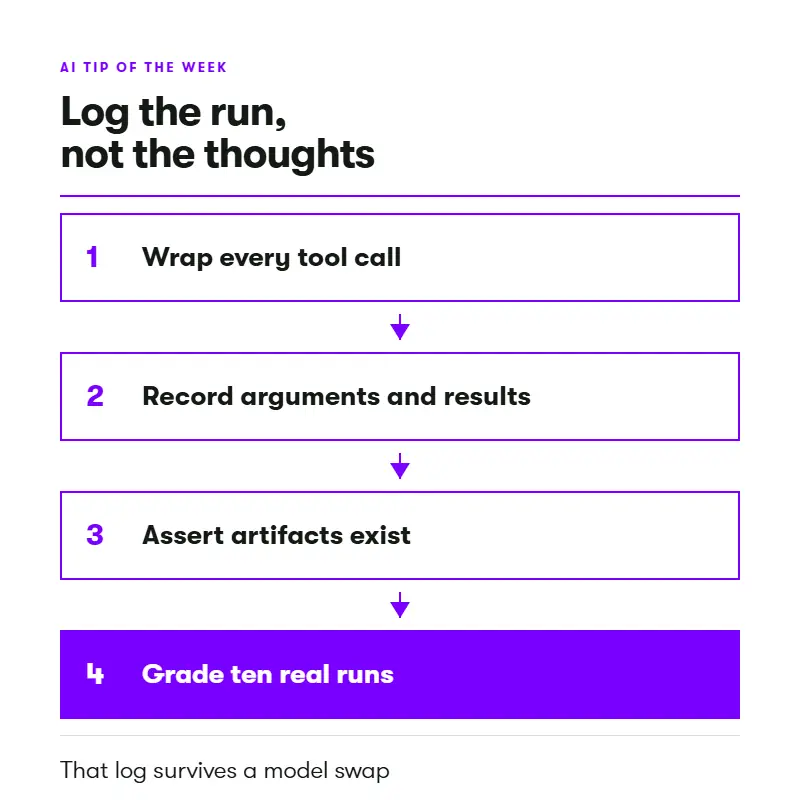
Treat AI observability as logging the run, not asking the model to explain itself. Wrap every tool your agent can call so it records arguments, result and duration. After each run, assert that the expected artifacts exist in the expected format and fail the run if they do not. Then have a domain expert grade ten real runs against a fixed rubric. That log survives a model swap.
The bottom line
Astra’s benchmark scores will be beaten within months. The monitoring gap will not close on the same schedule. Build AI observability into the system itself, so its behaviour can be reconstructed from your own logs and a model that thinks in private becomes an engineering constraint rather than a governance emergency.
Sources
Newsletters: The Deep View, Limitless FM, Exponential View, The Neuron, AI Valley, The AI Break, FinTech & AI is Eating the World, Salazar AI News.
- OpenAI, Safety overview: GPT-6 Astra
- TechCrunch, OpenAI’s new reasoning technique alarms AI safety experts
- METR and Redwood Research, Hugging Face incident investigation
- MarkTechPost, Anthropic releases Claude Commerce Agents
- TechCrunch, Abliteration.ai is making a business out of removing AI guardrails
- Axios, Meta debuts Muse Spark 1.3