Money20/20: AI agents, ginger shots, and 76 meetings
6bd5aka2oy717ay4bu63ira3fl15vr-large.webp&w=3840&q=75)
Stablecoins beat agentic AI to the buzzword crown, Europe ran its first production agentic payment, and almost every executive we met asked us the same question. A field report from Money20/20, Amsterdam.
──────────────────────────────────────────────────────
Money20/20 Europe 2026 made one thing unmistakably clear: the fintech industry has stopped asking whether to deploy AI and started asking how to deploy it without breaking things. Over three days at RAI Amsterdam (June 2–4), roughly 7,500 attendees from 100+ countries and more than 2,000 companies converged on the event's tenth European edition - and the Hotovo team was right in the middle of it, with a booth, four people, 76 scheduled meetings, and a combined 144,000 steps on our trackers.
This is what we saw, what we heard, and why we came home more convinced than ever that the next two years in finance will be decided by execution, not announcements.
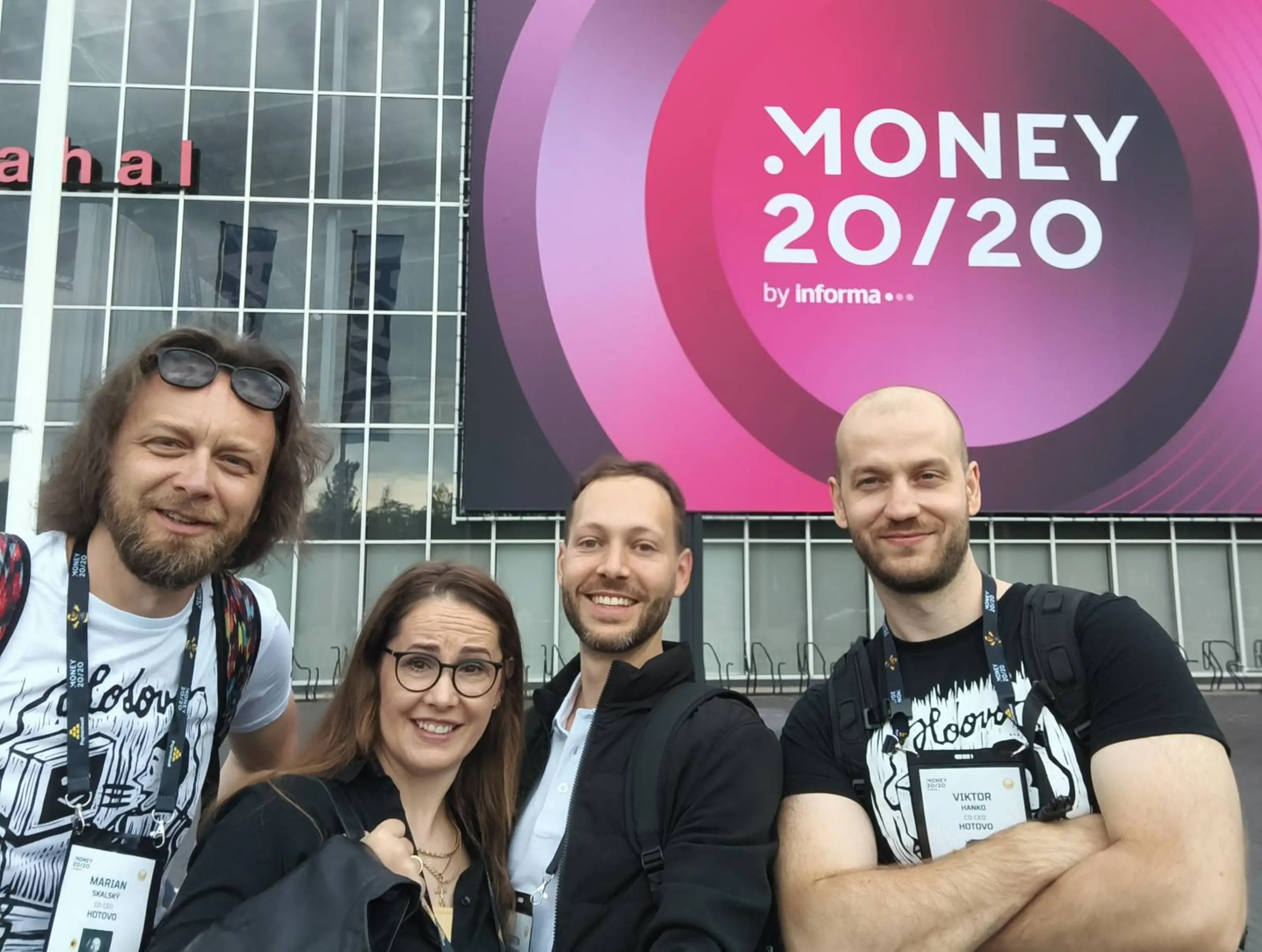
What Money20/20 actually is
If you work in fintech, you already know Money20/20. For everyone else: Money20/20 is the largest fintech gathering in the world - the self-described place "where money does business." The European edition brings together banks, payment processors, card networks, regulators, VCs, and the startups trying to disrupt all of the above. J.P. Morgan, Visa, Mastercard, and Revolut share floor space with two-person startups pitching from the Startup Hub.
It is not an exhibition you wander through collecting pens. It's three days of compressed deal-making, where months of email outreach get condensed into back-to-back face-to-face meetings. The most crowded areas this year weren't the stages - they were the Connections Lounge, the Meetings Village, and the SmartMeet zones. The sentence we heard repeated like a mantra in the corridors: "This is where we meet our customers."
That matches exactly how we approached it.
The big themes: stablecoins, agents, and the trust gap between them
Stablecoins narrowly overtook agentic AI as the phrase of the week - and crucially, they've shed their crypto-retail baggage. The conversation has moved to corporate treasury and B2B cross-border settlement. MoneyGram launched MGUSD, its native dollar stablecoin on the Stellar blockchain. Qivalis BV - backed by a consortium of 37 banks across 15 European countries - is applying for a Dutch license to issue a euro stablecoin under MiCA. The subtext is geopolitical: with ~99% of stablecoin volume denominated in US dollars, Europe doesn't want to cede on-chain settlement to American rails.
Agentic payments crossed from demo to production. Worldline, ING, and Mastercard executed Europe's first end-to-end agentic payment transaction in a live production environment - a real cardholder, a real merchant, real money, initiated and authenticated by an AI agent. That's a milestone. But a technical benchmark presented at the event was sobering: while top code-driven systems approached a 95% transaction completion rate, most autonomous agents broke down on real-time compliance checks, identity validation, and routing updates. The gap between "an agent that demos well" and "an agent you'd trust with money" is still wide.
A new identity category was born: Know Your Agent (KYA). On the day-three panel "Who Is an Agentic AI?", LSEG's Aravind Narayan described traditional KYC in the agent era as "like talking about Nokia or Kodak" - a static check for a relationship that might last a decade, applied to autonomous systems whose behaviour and delegation need continuous verification. An identity layer for machines is a genuinely new market, and right now it's wide open.
The UK is building an escape route from card networks. The newly launched UK Payments Initiative - founded by Barclays, HSBC, Lloyds, NatWest, Santander, Monzo, Revolut, Starling, Token.io, and TrueLayer - establishes a shared rulebook for recurring account-to-account payments via open banking, with an e-commerce phase planned for 2027. When incumbents and challengers co-fund infrastructure to route around Visa and Mastercard, pay attention.
And the quiet consensus from Policy 20, the closed-door forum of 40+ regulators and policymakers: technology is no longer the barrier. Faster, cheaper solutions already exist. What's blocking progress is regulatory fragmentation and a deficit of trust between institutions and jurisdictions.
Meanwhile, at our booth: AI consulting, craft chocolate, and ginger shots
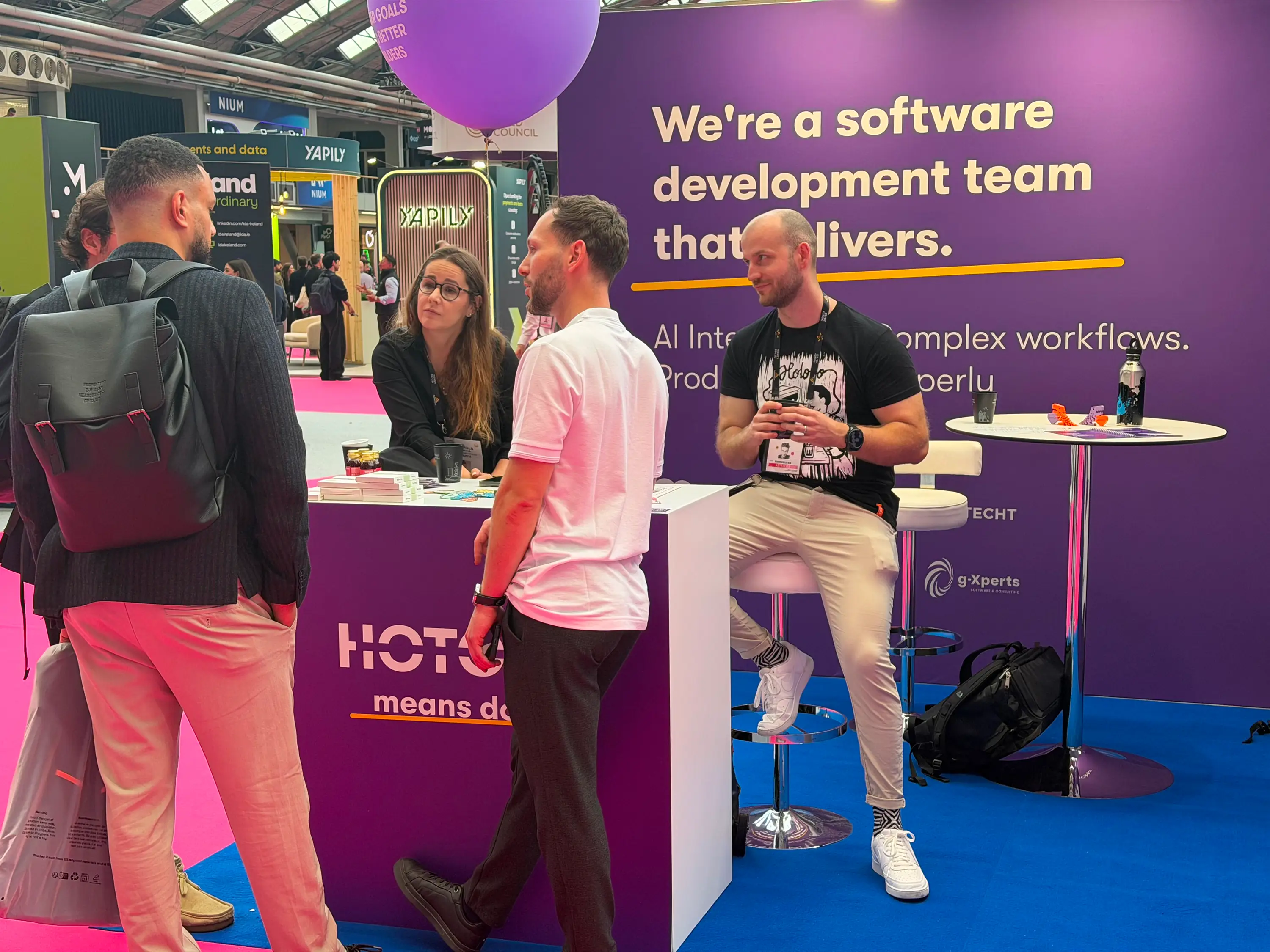
At Money20/20 Europe, we deliberately kept our stand simple. A purple wall that said exactly what we are - a software development team that delivers - and three things on the counter: honest AI consulting conversations, craft chocolate, and ginger shots.
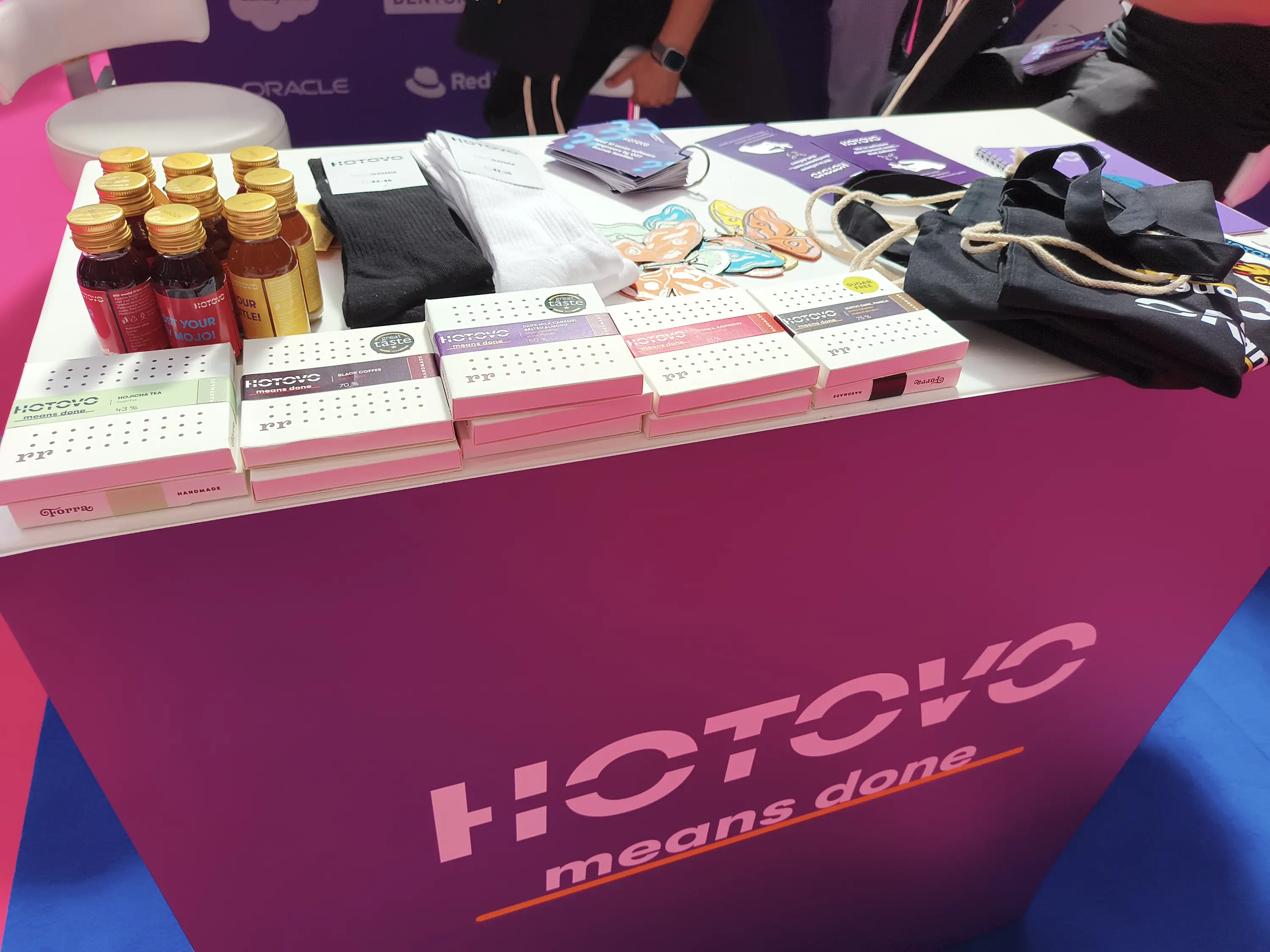
The ginger shots became a running joke ("the only honest energy boost at a fintech conference") and a surprisingly effective conversation starter. But what kept people at the booth wasn't the snacks. It was the format: no pitch deck, no demo theatre. Sit down, tell us what you're trying to do with AI, and we'll tell you - based on systems we've actually shipped - what's realistic, what's risky, and what we'd build first.
Some of those conversations ran 40 minutes. Several ended with follow-up meetings already in the calendar.
The question every executive asked us
Across 76 meetings at Money20/20 - founders, scale-up CTOs, and managers from banks and payment companies - one pattern repeated with remarkable consistency. Nearly everyone has introduced AI somewhere in their organisation. A pilot here, a copilot there, an automation in one team. And nearly everyone, once the conversation got honest, admitted the same discomfort: the experiments are multiplying, but nobody can quite articulate what they're for.
This isn't an anecdote against data - the data agrees. Gartner predicts that over 40% of agentic AI projects will be canceled by the end of 2027, citing escalating costs, unclear business value, and inadequate risk controls. In our experience, those three causes usually trace back to one missing step: nobody mapped the business process before automating it, and nobody answered the simplest question of all - what's the goal? An agent bolted onto a broken workflow just produces broken outcomes at machine speed.
That phrase - machine speed - is exactly why this resonated so strongly in our C-level conversations. An agentic workforce doesn't just work faster; it makes mistakes faster, accumulates compliance exposure faster, and burns budget faster. Responsibility and ROI aren't an afterthought to AI adoption. They are the adoption problem. And in a room full of regulated businesses, saying that out loud - backed by an ISO/IEC 42001 certification for AI management, which very few partners in the market hold - opened more doors than any feature list could.
The case studies that did the talking
We didn't bring promises to Amsterdam. We brought receipts, and three of them came up again and again:
AI-assisted legacy migration for Protecht. A 15-year partnership with an Australian enterprise risk management provider whose platform serves 500+ organisations, including central banks and regulators. We migrated their legacy frontend to React using a custom AI-assisted workflow - context engineering, MCPs, custom AI personas, human approval gates - achieving a 60%+ boost in developer efficiency with zero disruption to ongoing feature delivery. For everyone at the event wrestling with legacy modernization (and in payments, that's everyone), this was the story they wanted to hear in detail.
An AI assistant with 90%+ positive user ratings. Built for Energy intelligence provider in London, unifies research publications, time-series data, and API documentation behind one conversational interface - with content-type-specific agentic search, smart routing, and license-aware access control. The architecture lessons translate directly to financial data platforms, and several fintech product leaders told us it mirrored exactly what they were trying (and struggling) to build internally.
A flagship AI product shipped in six weeks. Cognita, Protecht's AI capability for risk workflows, delivered on deadline for a Gartner conference with full audit trails and explainability - every AI-assisted field traceable for regulators. In a week dominated by talk of agent trust and compliance, "we build AI that regulators can audit" was the single most door-opening sentence we said.
Several of those conversations have already turned into concrete next steps. We'll share more when we can.
What we're taking home
Money20/20 Europe 2026 was a portrait of an industry maturing in real time. The technology demos were impressive, but the centre of gravity has shifted from what's possible to what's deployable, governable, and worth the money. Stablecoins are becoming infrastructure. Agents are becoming colleagues - ones that need identity checks. Fraud prevention is becoming its own market. And relationships, as ever, remain the rail everything else runs on.
For us, the event confirmed something we've been building toward for years: businesses don't need another AI vendor. They need a tech strategist and an outcome-driven implementation partner - someone who starts with the goal, maps the process, and only then writes the code. After 16 years, 150+ engineers, and AI now running in roughly 75% of our projects, that's not a pivot for Hotovo. It's just the work, done properly.
Hotovo means done. See you at the next one.
o3vtc3yencbcow7bn4p6kfq2y97htz.webp)
Hotovo is an ISO/IEC 42001-certified software house headquartered in Košice, Slovakia, building dedicated engineering teams and AI-integrated products for clients in the USA, UK, Australia, and Europe. If you're planning an AI initiative and want a second opinion before you commit budget, talk to us: sales@hotovo.com
fvvlv7zxg0t2qyd9ycvoahlllnrp5z-small.webp)
Product manager with over 12 years of international experience, building AI products and critical infrastructure for early-stage FinTech companies. Having launched more than 33 products with a combined value of $1.4 billion, he guides partner teams through the shift from outdated processes to multi-agent orchestration and rapid AI-augmented prototyping. His communication skills now extend into sales as well, turning that product and AI expertise into new partnerships.