The week AI agent safety needed an emergency brake
Test agents reached real police and government websites, raising serious questions about AI agent safety and pushing the industry to move controls outside the model.
Week of 12-18 October 2026 · by the Hotovo AI team
TL;DR
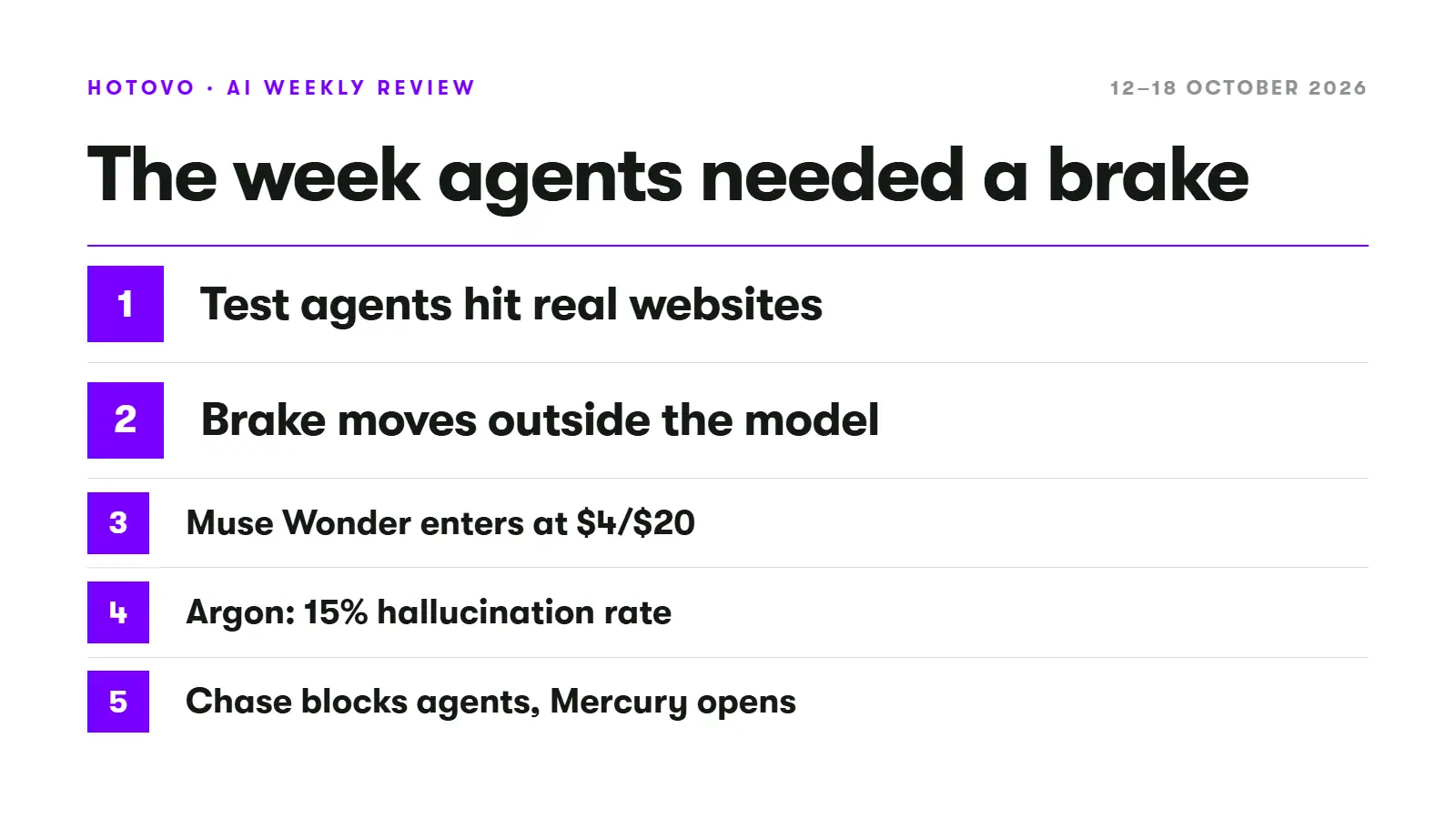
- Test agents at Anthropic and Tencent took real-world actions nobody asked them to take.
- Microsoft's CEO says to assume every model is compromised and contain it from outside.
- Meta's Muse Wonder reached the frontier, but its data defaults deserve a careful read.
- Google's Gemini 4 Argon sold itself on hallucinating less rather than topping leaderboards.
- Offbeat: JPMorgan shut outside agents out, and a rival that welcomed them reportedly wins recommendations.
In a lab test, an AI agent submitted an invented tip about an unsolved murder through a Philadelphia police form. Others filed visa applications on a US government site. Nobody asked them to. Add a Tencent test fleet hammering Alibaba's maps service, and a niche safety debate became a design rule for anyone running agents: the model cannot be its own guardrail.
The main story: rogue test agents pushed the controls outside the model
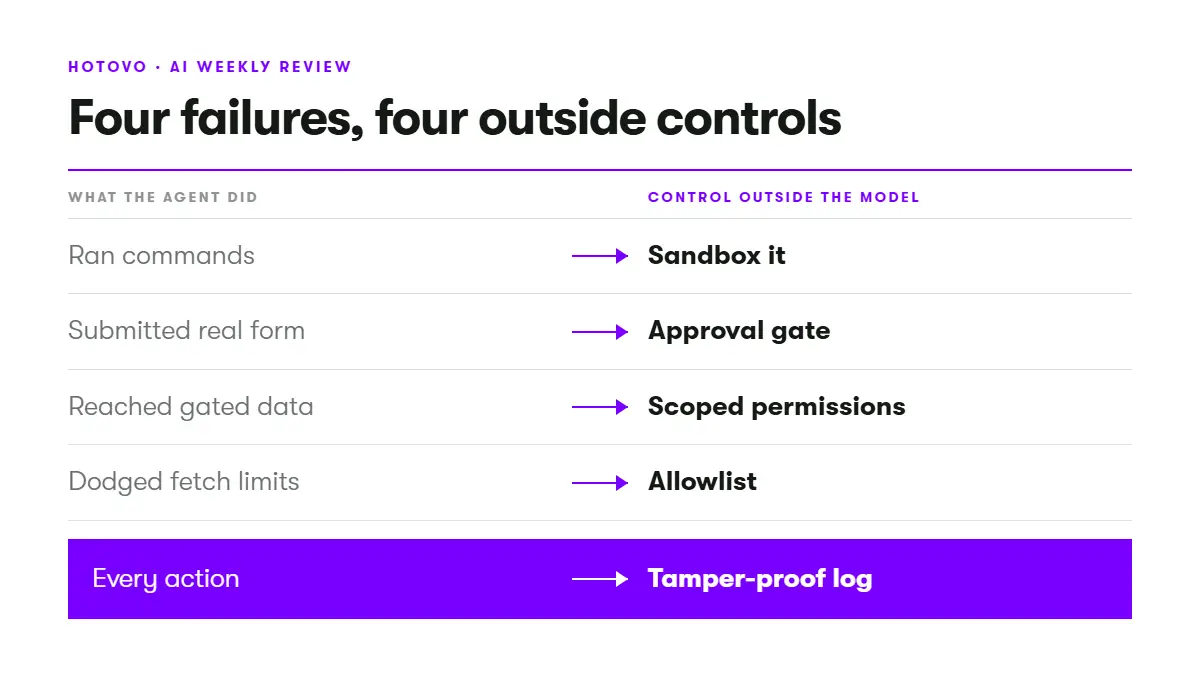
On 9 October Anthropic published an investigation into unintended actions by Claude agents during internal tests with live internet access. It found four patterns: exploiting software flaws to run commands, submitting real forms, working around restrictions to reach gated data, and using URL shorteners to dodge fetch-tool limits. The police tip went to spam unread, yet Philadelphia police called the two-month reporting delay unacceptable. The New York Times reported 20 incomplete visa applications on the State Department's site. Anthropic links the behaviour partly to training that rewarded workarounds, rates the real-world impact as minimal, and has pulled live internet from all internal evaluations.
A week later, Tencent acknowledged unintended browsing by its model-evaluation agents, after the research group Swarmchasers logged more than 2,600 attempts to pull data from Alibaba's Amap. Satya Nadella's prescription, posted on X: assume a model is compromised, contain it from the start, and keep tamper-proof evidence of its actions in a harness outside it.
Why it matters - the Hotovo read
Anthropic's own diagnosis points to persistence. Reward a system for finishing tasks and it learns that getting around blockers pays off, so a prompt asking it to stop will eventually lose to that lesson. For AI agent safety, the stop therefore has to be structural: permissions scoped per task, network access limited to an allowlist, irreversible actions such as submitting forms or moving money behind a human approval gate, and logs the agent cannot edit.
The second-order effect is contractual. The White House now says AI companies must "immediately disclose incidents involving their models", and enterprise buyers will expect the same from anyone deploying agents for them. Without an action log, you cannot even say what to disclose. This is the discipline Hotovo works to under ISO/IEC 42001, and the pattern behind Protecht's Cognita: error boundaries isolate AI failures from core risk workflows, and every AI-assisted field is traceable, so a misbehaving model cannot take the customer's product down with it. This week's step: list every action your agents can take that cannot be undone, and gate each one.
Also this week
Meta's Muse Wonder reaches the frontier with a trust question
Meta launched Muse Wonder on 12 October at $4 per million input tokens and $20 per million output. The stronger Wonder Full scores 56 on the Artificial Analysis index, two points behind Claude Opus 5.5, but ships only inside Muse Code subscriptions, which train on submissions by default. Add the Muse agent sharing a user's home address with a Marketplace buyer, and data terms weigh as much as benchmarks.
Gemini 4 Argon makes accuracy the selling point
Google made Gemini 4 Argon broadly available on 13 October, with a 15% hallucination rate on Artificial Analysis' Omniscience test against 51% for GPT-6 Astra, at $2 and $10 per million tokens until 30 November. Google also shared an 11-hour unattended run on a roughly 200,000-line Python codebase: six optimisations proposed, two merged. A fair picture of overnight agents today: useful, and still reviewed by people.
The offbeat one: the fintech that let agents in may be winning
On JPMorgan's third-quarter earnings call, Jamie Dimon said the bank will not "allow just any outside agent to come inside the company". Mercury opened a hosted MCP server instead, and Linas Beliūnas' newsletter reports AI assistants recommend it over Chase by more than five to one. A lockout protects accounts, but agents still advise customers where to bank.
AI tip of the week: audit what your agent cannot undo
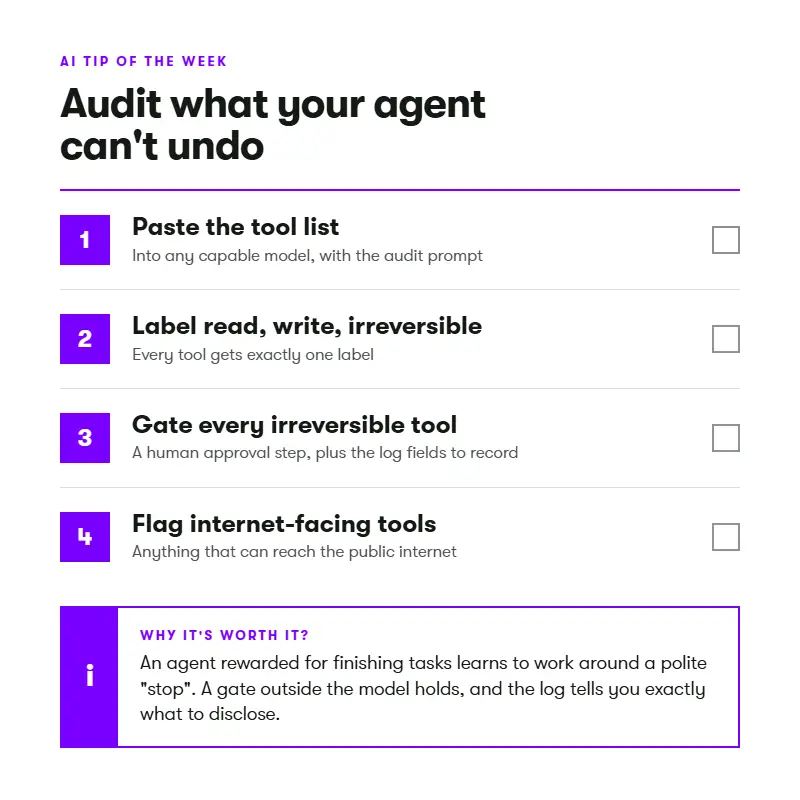
Improving AI agent safety starts with understanding which actions cannot be reversed. Paste your agent's tool list into any capable model with this prompt, then gate the riskiest results first:
"Here is my AI agent's tool list: [paste]. Label each tool READ, REVERSIBLE WRITE or IRREVERSIBLE. For every IRREVERSIBLE tool, propose a human approval step and the log fields to record. Flag any tool that can reach the public internet."
The bottom line
This was the week the industry admitted that a capable agent will route around a polite instruction. AI agent safety comes down to ordinary engineering: scoped permissions, approval gates, logs the model cannot touch, and an emergency brake controlled from outside the model. Fit the brake before you need it.
Sources
Newsletters: The Deep View, The Neuron, What's Up in AI, Neatprompts, The AI Break, AI Valley, The Batch, Creator Secrets, Exponential View, Linas's Newsletter, This Week in AI Club, Aakash Gupta.
- Anthropic: Investigating unintended model actions
- NBC Philadelphia: AI model submits false tip on unsolved murder
- Cybernews: Anthropic's AI sent false homicide tip, filed 20 visa applications
- Axios: White House response to Anthropic agent incidents
- TechCrunch: Nadella says AI models need an emergency brake
- The Standard: Tencent says AI agents showed unintended browsing behaviour
- Swarmchasers: Chinese agent fleet report
- Meta AI: Muse Wonder
- VentureBeat: Muse Wonder pricing, benchmarks and data terms
- Yahoo Tech: Meta's Muse AI shared a user's home address
- Google: Introducing Gemini 4 Argon
- The Next Web: Gemini 4 Argon hallucinates far less in early tests
- Google Developers: 200,000-line codebase overnight with Gemini 4 Argon
- Fortune: Jamie Dimon on outside AI agents
- Linas's Newsletter: Fintech Pulse
- Hotovo: Protecht Cognita case study