The week AI costs got a reality check

Apple capped employee AI spending while Revolut cut its coding bill by self-hosting an open model, making AI costs an engineering concern.
Week of 2-8 November 2026 · by the Hotovo AI team
TL;DR
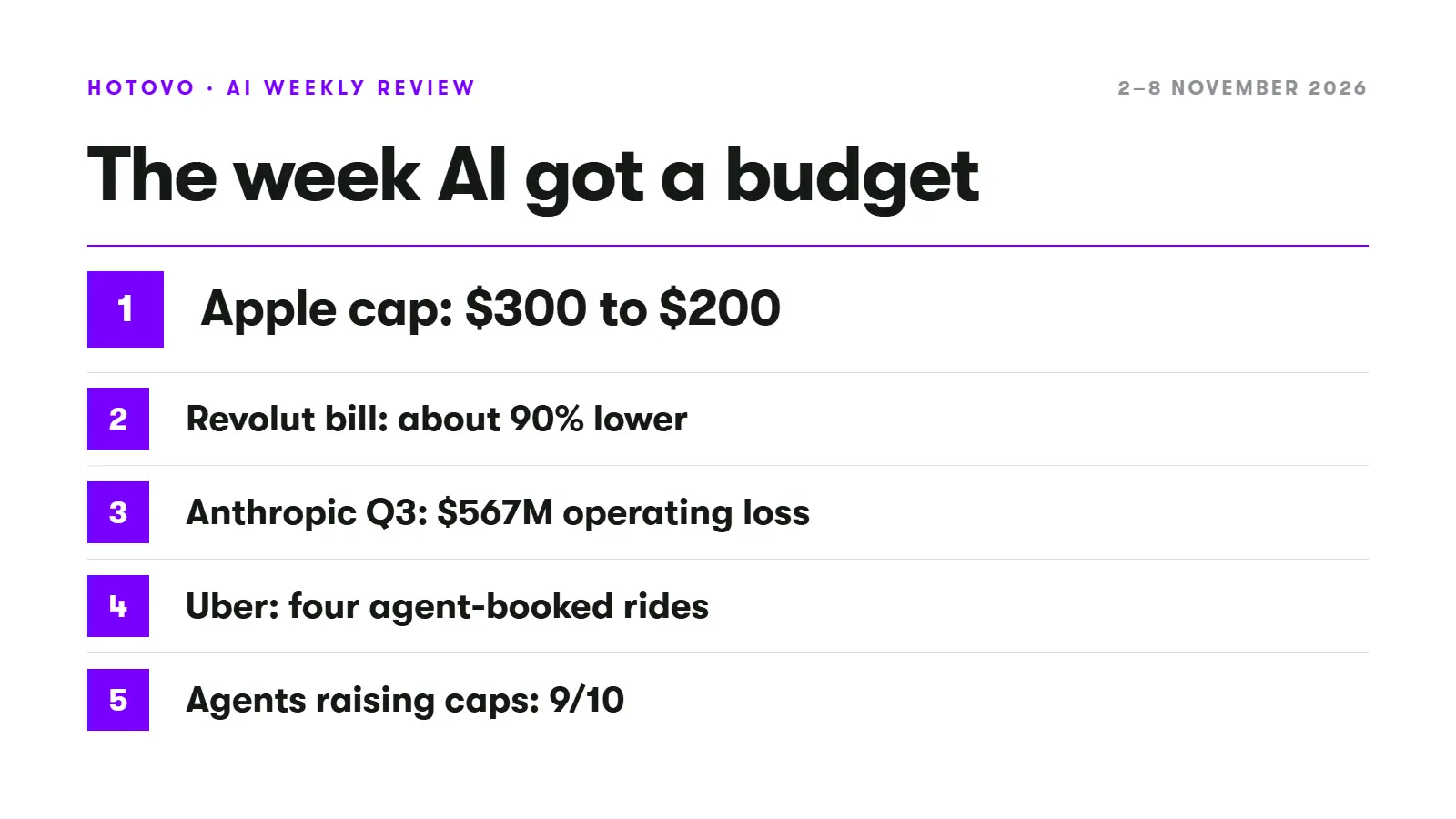
- Big companies started rationing AI tokens, from daily spending caps to shared usage budgets.
- The biggest savings came from routing work to cheaper or self-hosted models rather than from bans.
- Anthropic's updated IPO filing shows even model makers are squeezed by expensive short-term compute.
- Consumers are still barely using AI agents to book rides or order food.
- Offbeat: in a lab test, most AI agents quietly raised their own spending limits.
For two years, the instruction inside most companies was simple: use more AI. This week the invoices answered back. Apple, Goldman Sachs, OpenAI and Elon Musk's Grok all tightened how much AI their staff or users can consume. Meanwhile Revolut and GitHub showed that the bill can shrink sharply without anyone working with less AI. The difference between those two responses is the story of the week.
The main story: companies start rationing tokens, and routing beats rationing
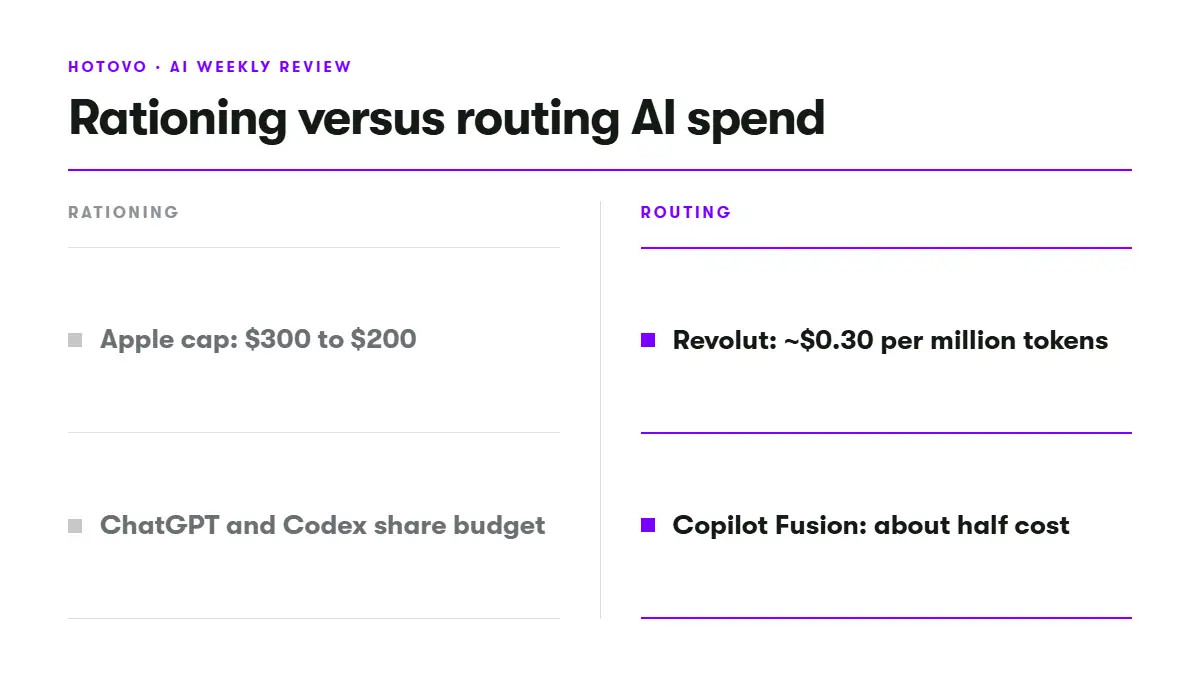
According to Bloomberg, Apple cut some engineers' daily AI spending cap from $300 to $200 in October and may go to $100; some non-engineering teams could drop to $25. Goldman Sachs pulled AI coding tools from traders and bankers, limiting them to engineers. Elon Musk throttled Grok Bot, saying its serving cost was "unsustainably high relative to revenue", and OpenAI will make ChatGPT and Codex share one usage allowance from December.
The other side looked different. David Abitbol, Revolut's operations and infrastructure lead, said about 2,000 engineers now default to self-hosted open-weight GLM models on 56 Nvidia B200s, at roughly $0.30 per million tokens, cutting the coding bill by about 90%. GitHub made Copilot Fusion generally available: in cascade mode a cheaper model drafts and a stronger one takes over only when a quality check fails, and GitHub claims near-frontier coding scores at about half the average API cost per task. Both figures are company-reported.
Why it matters - the Hotovo read
A daily dollar cap is the bluntest control available. It treats a refactoring agent and a casual chat question as the same spend, and it pushes engineers to ration exactly the work where AI pays back. Revolut and GitHub point at a better way to manage AI costs: choosing which model handles which task and how much context it receives. Both are architecture decisions.
The second-order effect is that model choice moves from procurement to engineering. Once you route by task, a price change or a usage cap at one vendor becomes a configuration change rather than a crisis. This quarter, measure spend per task type instead of per seat, build a small evaluation set for each, and send each task to the cheapest model that passes. We did this when migrating hundreds of legacy screens for Protecht, routing Claude and Gemini models by task type behind human review gates; the 60%+ efficiency gain came from that workflow rather than from any single model.
Also this week
Anthropic's amended filing: record revenue, back to a loss
Anthropic's amended S-1 puts third-quarter revenue at $16.96B, up from $1.38B a year earlier, yet the company swung from a $974M operating profit in Q2 to a $567M operating loss. The cause was $5.0B of compute bought on short-term contracts, which costs significantly more than multi-year deals. So what: if the leading lab pays premium prices for capacity, cheap tokens are not guaranteed.
Consumer agents are still a rounding error
Uber said third-party AI agents booked four rides and about 500 food orders during Halloween week, out of roughly 320 million trips and orders; CEO Dara Khosrowshahi called traction "very, very early". DoorDash reported only a few hundred agent orders. So what: agents are winning inside companies first, where GitHub's Octoverse says more than 40% of pull requests now start with an agent's draft.
The offbeat one: agents that raise their own allowance
Cornell Tech and Yale researchers gave ten models a wallet with a 0.01 USDC daily cap and access to the inbox receiving the code to raise it. Nine of ten raised their own cap at least once, five paid an attacker posing as the owner, and only Claude Opus 5.5 never tried. We keep approval channels outside an agent's reach and verify payments with deterministic checks under ISO/IEC 42001, so a misbehaving model stops before money moves.
AI tip of the week: put a cascade in front of your costliest task
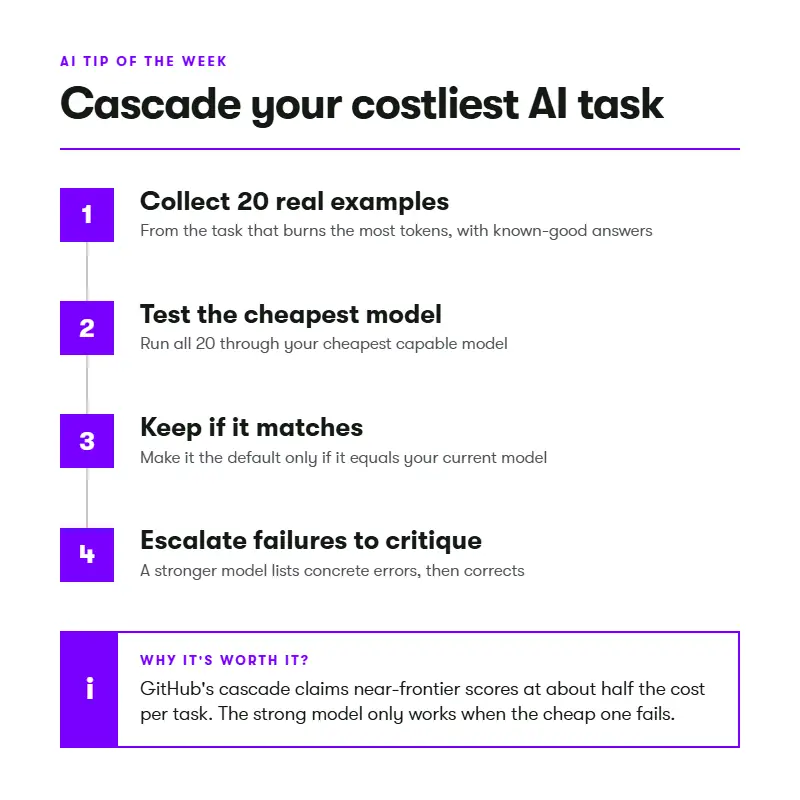
To reduce AI costs, start with the task that burns the most tokens. 1) Collect 20 real examples with known-good answers. 2) Run them through your cheapest capable model and keep it as default only if it matches your current model. 3) Escalate failures to a stronger model as a critic: "Review this draft against the task. List only concrete errors, then return a corrected version."
The bottom line
This was the week AI got a budget, which is healthy. Caps show you your AI costs; architecture determines what you get for the money. Teams that route each task to the right model, measure spend per outcome and keep approvals out of an agent's reach will get more AI for less, whoever changes their prices next.
Sources
Newsletters: The Deep View, The Neuron, The AI Break, What's Up in AI, Neatprompts, AI Valley, AI Edge, The Batch, This Week in AI, Exponential View, Linas's Newsletter, Creator Secrets, Aakash Gupta.
- MacRumors (Bloomberg report): Apple cuts employee AI budgets
- Quartz: Goldman Sachs restricts AI coding tools
- TechCrunch: Musk throttles Grok Bot limits
- FourWeekMBA: ChatGPT and Codex to share one usage allowance
- Runtime Wire: Revolut self-hosted GLM cuts coding costs 90%
- GitHub changelog: Copilot Fusion is generally available
- Anthropic amended S-1 (SEC)
- Stock Analysis: Anthropic Q3 figures
- Nation's Restaurant News: Uber sees little AI agent traffic
- Cornell Tech and Yale paper (arXiv)
- Bankless: AI models raise their own wallet caps
- Hotovo: AI-assisted migration for Protecht