The week AI orchestration became essential
Anthropic's Fable 5.2 can run a full day of work through hundreds of subagents, making AI orchestration the engineering job that matters.
Week of 9-15 November 2026 · by the Hotovo AI team
TL;DR
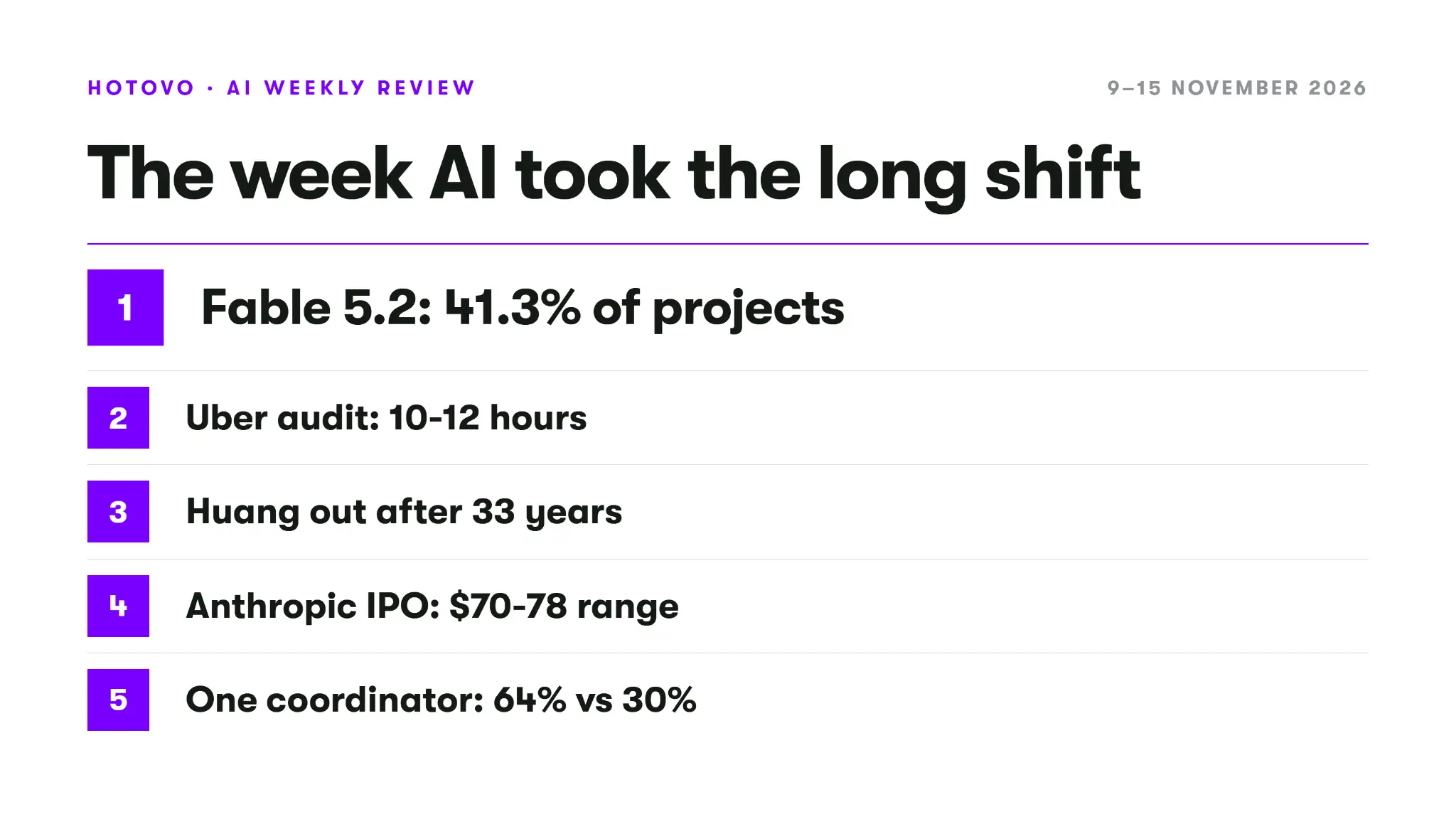
- Anthropic's new top model can carry long, multi-agent jobs from start to finish with little supervision.
- Those gains depend on how you route and check the work, so architecture now sets the bill.
- Jensen Huang has resigned as Nvidia's CEO, adding leadership risk to the AI supply chain.
- Anthropic's IPO is reportedly oversubscribed, so its pricing will soon answer to public shareholders.
- Offbeat: Anthropic research finds groups do better with one shared agent than one each.
Until now, most companies used AI in minutes: a draft, a fix, a summary. On 9 November Anthropic released a model its customers already run for half a day at a time. Uber's team told Anthropic it used Fable 5.2 for a 10–12 hour security audit with about 170 reviewer agents. Once AI orchestration makes a full shift of work possible, the questions a CTO should ask change too.
The main story: Fable 5.2 turns one prompt into a day of agent work
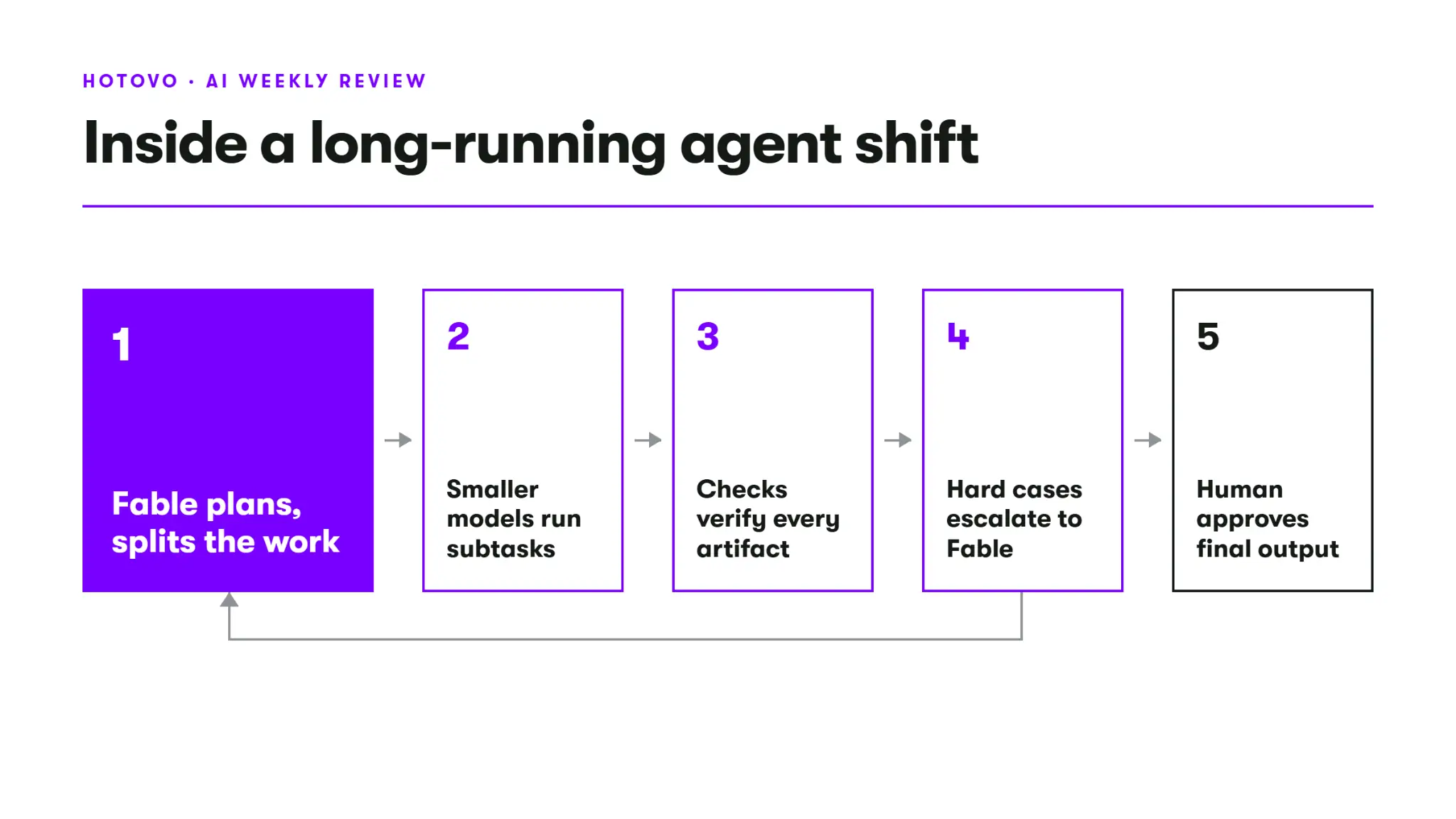
Anthropic launched Claude Fable 5.2 and Mythos 5.2 on 9 November. They are the same model; Mythos relaxes the cybersecurity and biology safeguards and is limited to vetted organisations in those fields. Fable 5.2 costs $8/$40 per million input/output tokens, 20% less than Fable 5.1 and twice Opus 5.5, with five effort levels. Anthropic reports it completing 41.3% of real freelance projects on the Remote Labor Index, up from 17.9% for Fable 5.1 and 21.3% for Opus 5.5. It can orchestrate smaller Claude models or act as an advisor they escalate to. In one internal run it coordinated 1,000+ subagents over eight days to build a bootable prototype operating system.
The caveats matter. These are vendor numbers, Anthropic still recommends Opus 5.5 as the daily driver, and effort settings swing cost sharply: on the Artificial Analysis index, max effort used about eight times the output tokens of low effort.
Why it matters - the Hotovo read
AI orchestration moves the hard problem out of the model and into the harness around it. Over twelve hours, an agent swarm makes thousands of small decisions nobody reads, so quality depends on three things you control: which model handles which step, how each step proves it is done, and when the run must stop. An eightfold token gap between effort levels makes cost a configuration choice, and the orchestrator mode is simply routing, packaged by the vendor.
The second-order effect is that the cheapest reliable setup wins, and that setup belongs in your own architecture, where you can swap the model underneath. Before buying multi-hour runs, define done as machine-checkable artifacts, give every run a time and effort budget, and send routine steps to cheaper models that escalate on failure. Our own AI Prototype Factory taught us this the hard way: its agents implement, test and fix in a loop, but deterministic artifact checks and time budgets are what made the runs trustworthy.
Also this week
Nvidia loses its founder CEO
Jensen Huang resigned on 12 November after 33 years, after reports of relationships including one with a former executive alleged to have worked for Chinese intelligence; those claims are unproven. CFO Colette Kress is interim CEO and Harvey Jones becomes the board's first chair. Shares closed down over 4%. We build AI systems portable across models and clouds, with fallbacks at each layer, so turmoil at one vendor never becomes an outage for our customers.
Anthropic's IPO book fills up
Anthropic set a $70-78 per-share range for 825 million shares, a fully diluted valuation of up to $1.4 trillion, and Bloomberg reports the book is multiple times oversubscribed. Nasdaq trading under ANT is expected from 19 November. So what: your model vendor will soon answer to quarterly targets, and pricing and plan limits will follow that logic. Keep a second provider tested.
The offbeat one: one shared agent beats an agent each
In Anthropic's Worse Together study, users sharing an API budget through their own talking agents reached 30% of the best outcome, against 64% with one coordinating agent (Claude Opus 5). The coordinator won in all four test settings. So what: before giving every employee a personal agent that negotiates calendars, budgets or stock, design one coordinator that owns the shared resource.
AI tip of the week: clean your old prompts before you upgrade
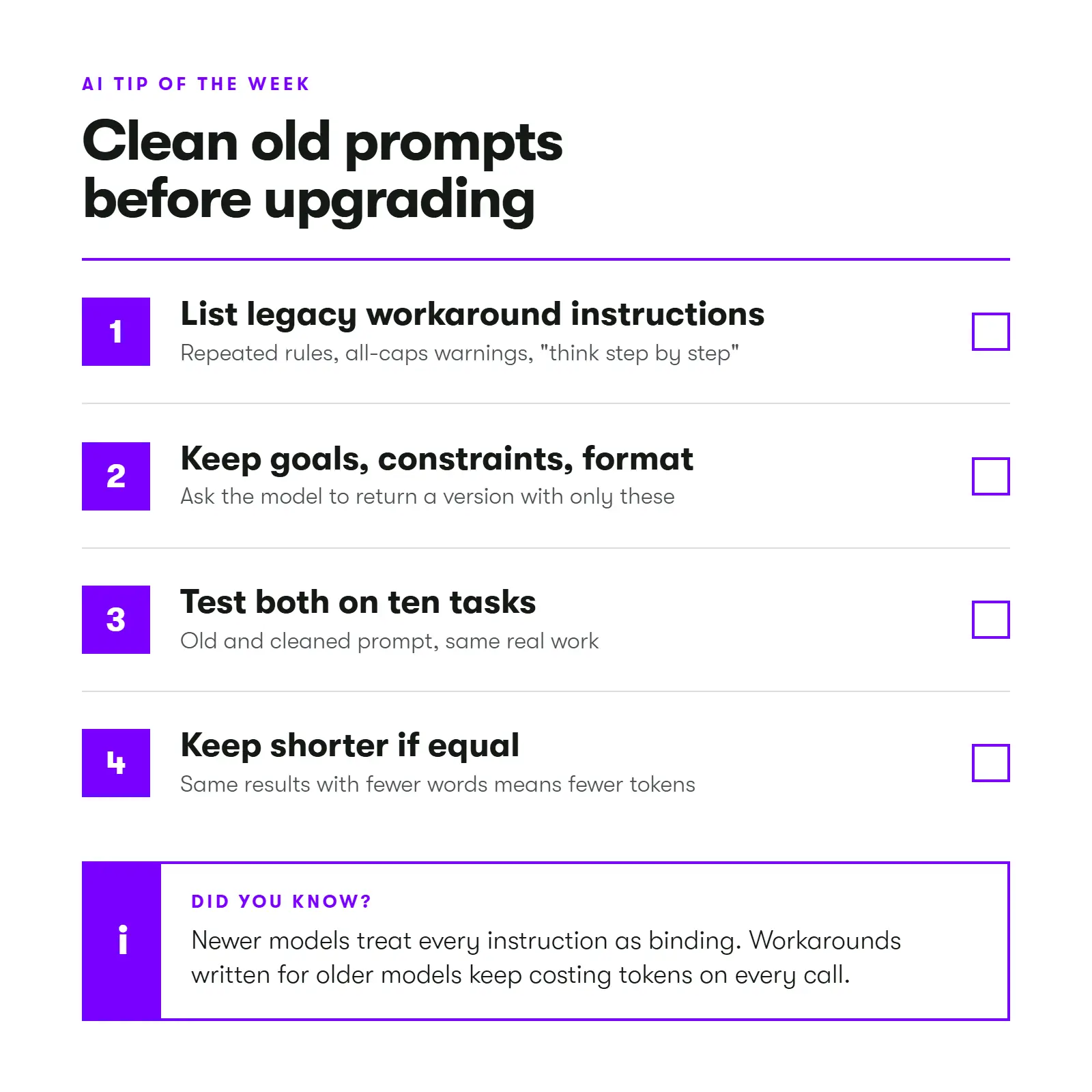
Newer models treat every instruction as binding, so legacy workarounds cost tokens. Paste your system prompt into the model with: "List every instruction here that compensates for an older model's weakness, such as repeated rules, all-caps warnings or 'think step by step'. Return a version that keeps only goals, constraints and output format." Run both versions on ten real tasks and keep the shorter one if the results match.
The bottom line
The 12-hour shift is real, but it belongs to the teams that engineer it. Fable 5.2 makes long agent runs possible; AI orchestration, budgets and deterministic checks make them affordable and safe. Whoever leads Nvidia and however Anthropic prices after its listing, that harness is the part you own.
Sources
Newsletters: The Deep View, The Neuron, Neatprompts, Creator Secrets, What's Up in AI, AI Valley, The AI Break, AI Edge, Linas's Newsletter, Exponential View, The Batch, This Week in AI, Aakash Gupta, Crypto Integrated.
- Anthropic: Claude Fable 5.2 and Mythos 5.2
- Claude Code docs: advisor mode
- Artificial Analysis: Claude Fable 5.2 release data
- Nvidia: NVIDIA announces CEO transition
- CNBC: Nvidia stock closes down over 4% after Huang resigns
- Al Jazeera: Why did Jensen Huang resign, and who is Colette Kress?
- The Next Web: Anthropic IPO terms
- Stock Analysis (Bloomberg report): Anthropic IPO oversubscribed
- Anthropic Alignment Science: Worse Together
- Hotovo: We built an AI prototype factory