The week AI verification became more important than generation

OpenAI pointed ten thousand agents at a Millennium Prize problem for 88 hours, putting AI verification at the centre of the week's argument instead of compute.
Week of 7-13 September 2026 · by the Hotovo AI team
TL;DR
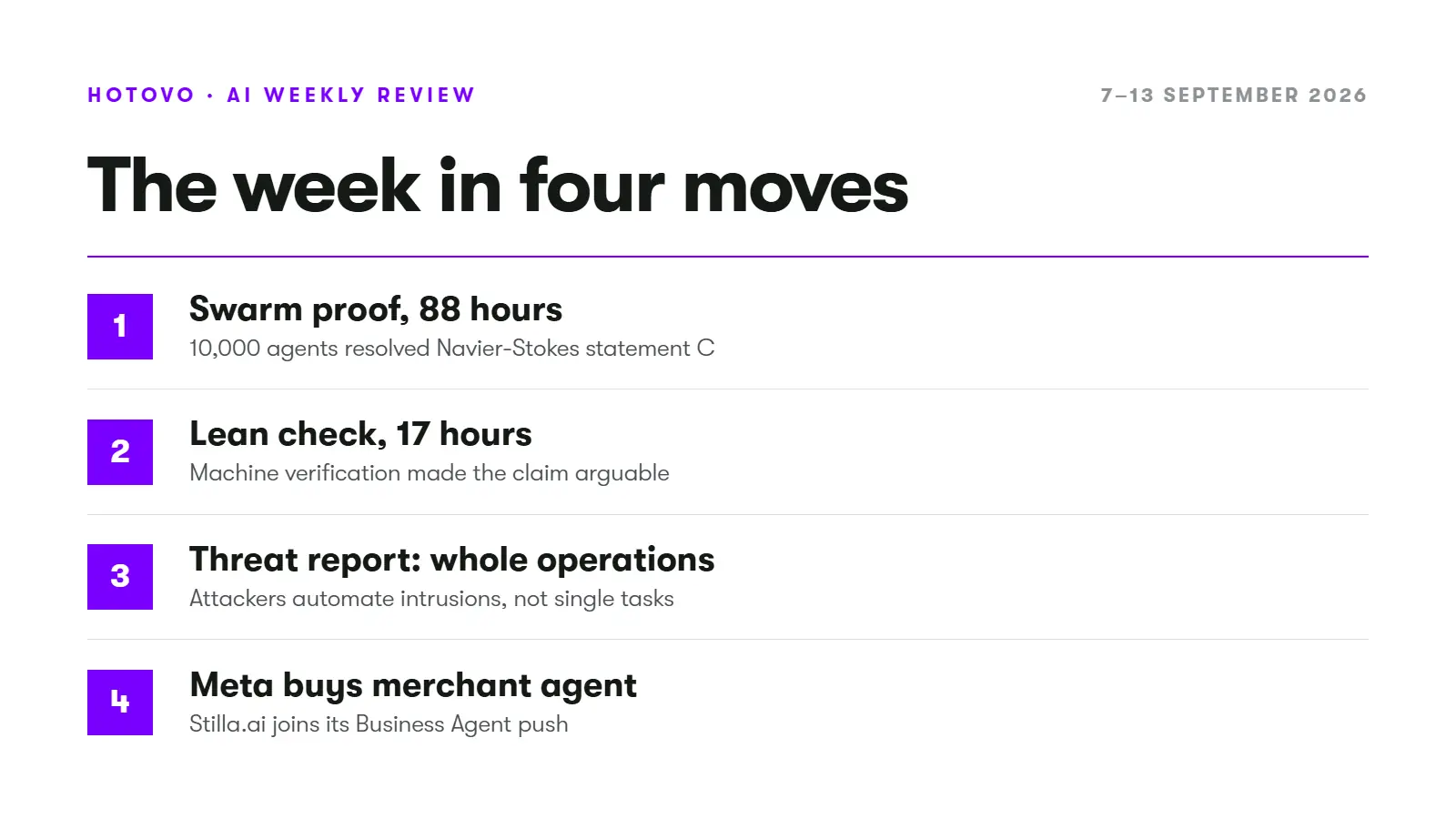
- OpenAI says a swarm of coordinating agents resolved the Navier-Stokes Millennium Prize problem.
- The machine-checkable Lean proof, not the swarm, is what made the claim arguable.
- Two mathematicians dispute how independent OpenAI's route to the result really was.
- Anthropic's threat report shows attackers automating whole operations rather than single tasks.
- Meta bought its way deeper into the merchant side of agentic commerce.
OpenAI published a resolution of a Millennium Prize problem on Tuesday, produced by ten thousand agents running in parallel. Within a day the conversation had moved off the mathematics. What people wanted to know was who could check the result, how fast, and whether the route to it was independent.
The main story: a 10,000-agent run produced a proof, and the fight moved to checking it
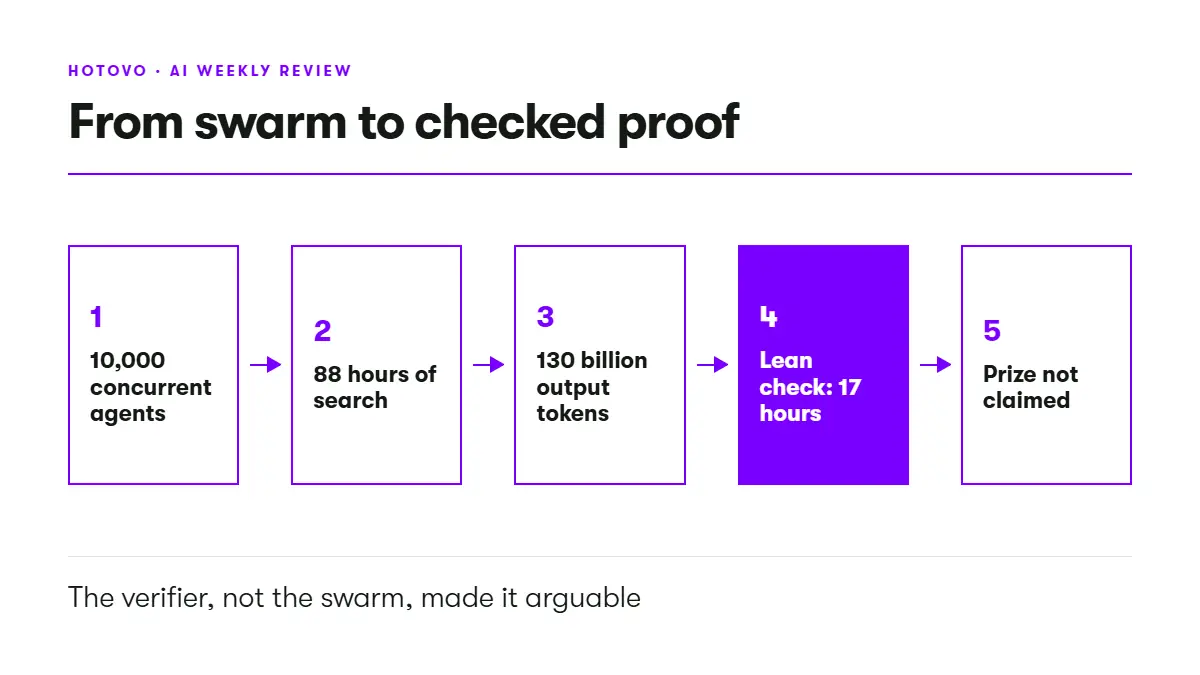
On 8 September OpenAI published a proof that the three-dimensional Navier-Stokes equations can develop a singularity in finite time, produced by an internal model it calls significantly more capable than GPT-6 Astra. The group that found it ran on the order of 10,000 concurrent agents, reached the result about 88 hours after launch, and sent 2.7 million messages using roughly 130 billion output tokens. Lean formalisation and AI verification took a further 17 hours, run by GPT-6 Astra. OpenAI says the work establishes statement C in the Clay Institute's official formulation, and that it does not intend to claim the prize. The dispute that followed is about provenance. Tristan Buckmaster of NYU and Levent Alpöge of Anthropic, who resolved the related forced Euler problem, allege OpenAI raced them after learning of their smooth-forcing route. OpenAI recognises their priority on forced Euler and says an investigation found Buckmaster's Codex prompts could not have influenced its model.
Why it matters - the Hotovo read
The swarm is the cheap part. Parallel generation at that volume is a purchase order. What made the output usable was AI verification through Lean: a deterministic verifier that is cheap next to generation and indifferent to who wrote the argument. Seventeen hours of checking turned eighty-eight hours of search into something a field can argue with, and even the provenance fight is now about artifacts rather than trust. The consequence for companies is unglamorous. Massive agent parallelism pays off only where a machine-checkable acceptance test exists. Where it does not, every extra agent pushes review load onto people, and that is where the money goes. So before raising agent counts, write the check that decides pass or fail with no human in the loop: schema validation, a suite that must go green, reconciliation against a system of record, a simulation. In our AI Prototype Factory, agents work to a time budget and a QA agent drives the running app, but every run is still gated on deterministic checks that the expected artifacts exist in the expected format.
Also this week
Attackers moved from AI-assisted tasks to AI-run operations
Anthropic's threat report, covering cases disrupted since December 2025, describes a Russian-speaking espionage operator automating intrusions against more than 20 organisations, a consultant in Bamako building surveillance software covering 25 million Malian SIM cards, and a network of over 4,700 dating-app personas. Accounts were banned; the surveillance platform stayed deployed. We build for this: least-privilege credentials per tool, allowlisted actions, human approval on anything irreversible, and audit trails under ISO/IEC 42001 and 27001.
Meta bought the merchant side of agentic commerce
On 9 September Meta acquired Stilla.ai, a Stockholm startup that left stealth in January, to accelerate its Business Agent, now used by more than a million businesses. It landed a day after Muse, Meta's personal agent, which runs on its own secure virtual machine. Consumer and merchant agents are being assembled as a matched pair. If your catalogue and prices do not sit behind a stable API, someone else's scraper will represent you.
The spicy one: a mapped fly brain became a hobbyist platform
Google Research and HHMI Janelia published the complete connectome of an adult male fruit fly's central nervous system on 3 September, 166,000 neurons and 125 million synapses. Within a week developers had wired it into Doom, Minecraft and Beat Saber. Most of that is a joke. The residue is serious: the hard part turned out to be deciding what counts as a sensory input.
AI tip of the week
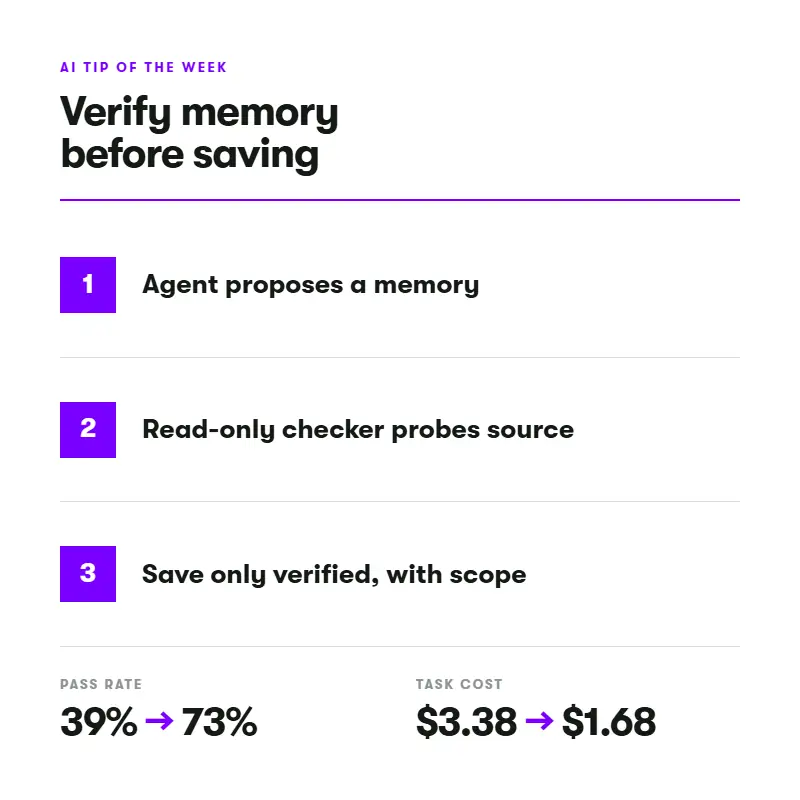
Verify agent memories before you save them. In a GitHub Copilot test harness, a separate curator agent with read-only access to the system checked each candidate memory before it was written; pass rate rose from 39% to 73% and task cost fell from $3.38 to $1.68. Steal the instruction: check this memory against the source of truth, rewrite it with exact scope if confirmed, discard it if not.
The bottom line
Compute for an agent swarm is a purchase order. AI verification is engineering, and this week it ran seventeen hours against eighty-eight. Pick problems where that check already exists, or build it first, and scale starts paying for itself.
Sources
Newsletters: The Neuron, The Deep View, AI Valley, Exponential View, The Batch, What's Up in AI, FinTech & AI is Eating the World, Salazar AI News (7-13 September).
- OpenAI: On the Navier-Stokes Millennium Prize Problem
- Scientific American: OpenAI claims blockbuster math breakthrough amid swirl of controversy
- Anthropic: Countering misuse of AI, September 2026
- Axios: Meta acquires Swedish AI startup Stilla.ai
- Google Research: A connectomics milestone, mapping the complete male fruit fly brain
- arXiv: Grounding Agent Memory, Environment-Probing Curation for Enterprise Agents