The week good-enough AI got cheap
AI got cheap as Anthropic and OpenAI slashed the price of capable models, making the real question which tasks still deserve a frontier model.
Week of 5-11 October 2026 · by the Hotovo AI team
TL;DR
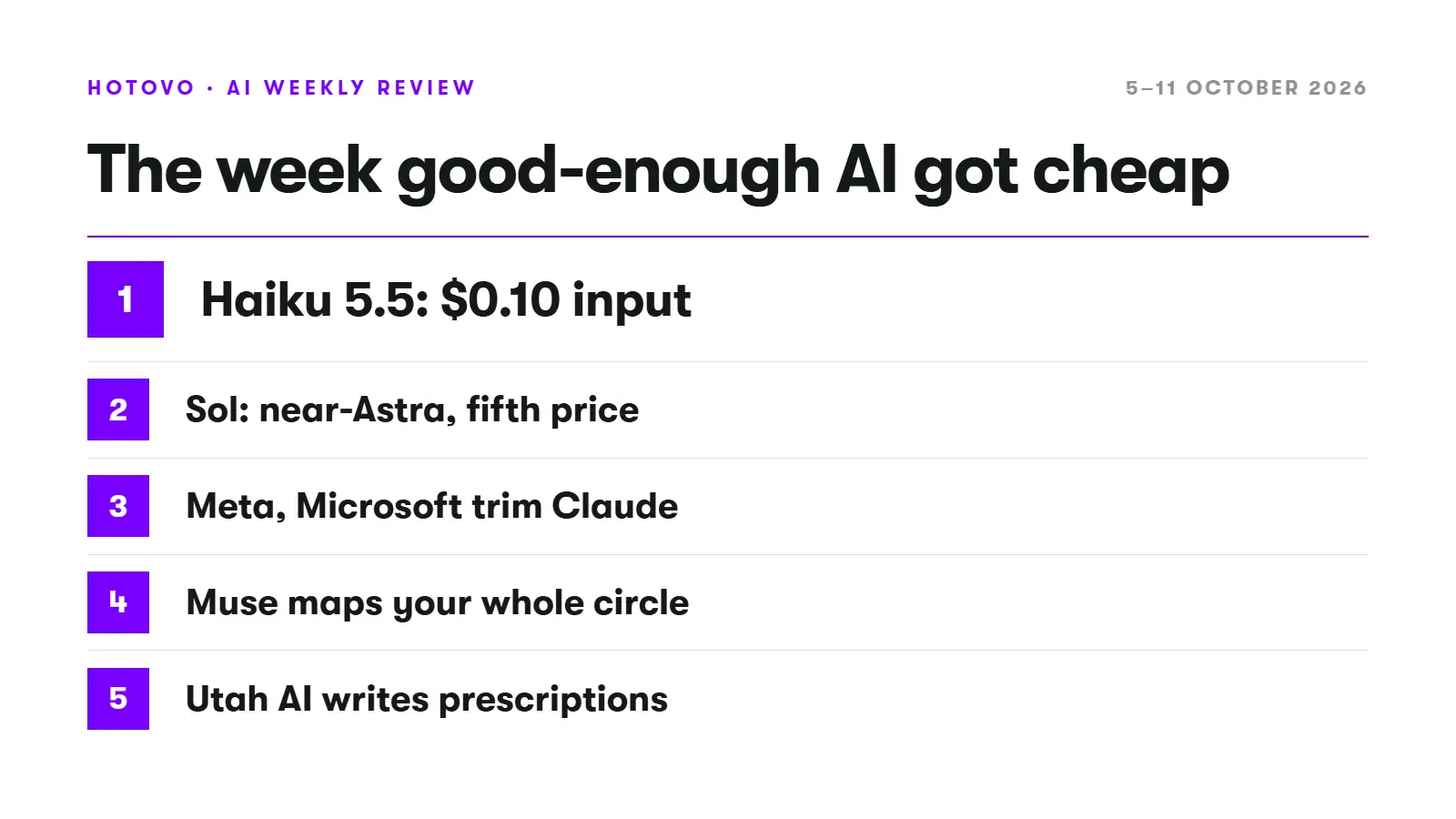
- Anthropic and OpenAI made capable mid-range models dramatically cheaper, resetting what good-enough AI costs.
- Cost per finished task now matters more than which model tops the leaderboard.
- Meta and Microsoft cut internal Claude use, a reminder that big buyers hedge their vendors.
- Meta's Muse showed how much an always-on personal agent collects, and Apple tightened Mac access.
- Offbeat: Utah let an AI app write first-time acne prescriptions under a supervised pilot.
For two years, every model launch argued about the top of the leaderboard. This week the action moved to the bottom of the price list. Anthropic shipped Claude Haiku 5.5 at a tenth of a dollar per million input tokens, and OpenAI's new mid-tier Sol scores almost level with its flagship at a fifth of the price. Capable AI got cheap enough to change the maths.
The main story: near-flagship quality now costs a fifth of the price
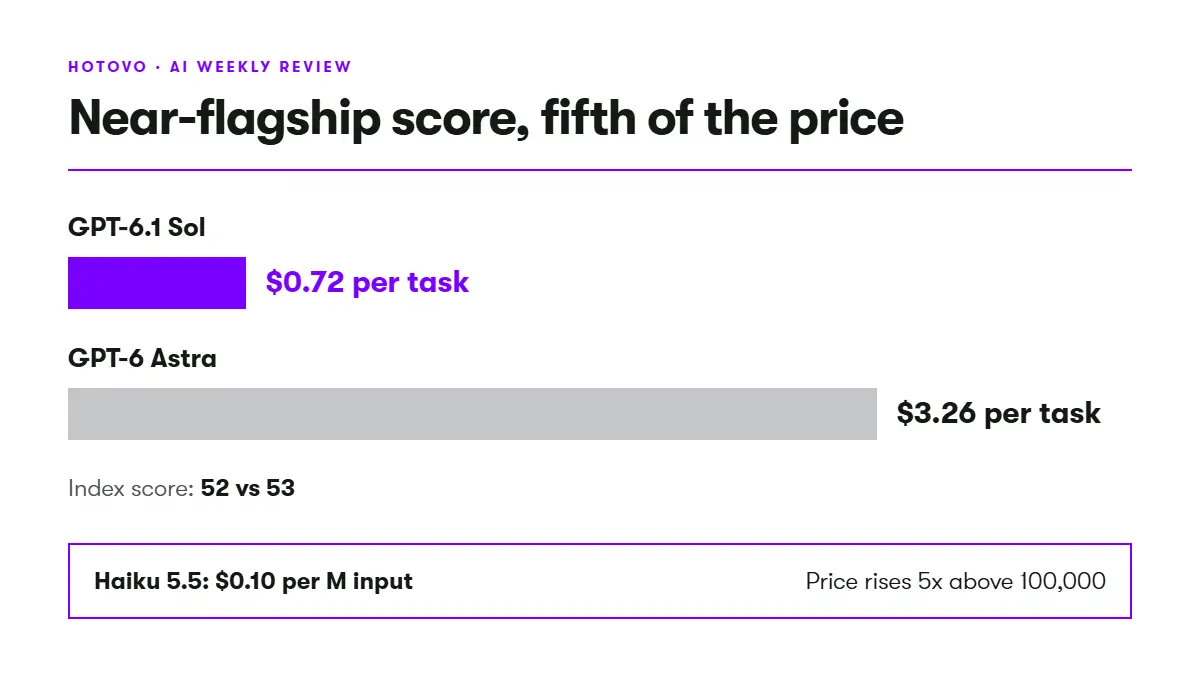
Claude Haiku 5.5 launched on 7 October at $0.10 per million input tokens and $0.50 per million output tokens for prompts under 100,000 tokens. Above that line, every price rises 5x. Anthropic says an average job costs around 75% less than on Haiku 4.5, and it is the first Haiku with an adjustable effort setting. Sonnet 5.5 cache reads were halved the same week.
OpenAI's GPT-6.1 Sol, launched at DevDay, costs $2 and $10 per million tokens against $10 and $50 for GPT-6 Astra. Artificial Analysis scores Sol at 52 against Astra's 53 on its intelligence index, at $0.72 per task versus $3.26, according to The Batch. Two caveats apply: benchmark costs vary by workload, and Haiku's 100,000-token cliff means long-context jobs can cost far more than the headline suggests.
Why it matters - the Hotovo read
AI got cheap, but a cheaper token only becomes a cheaper product when someone engineers for it. Haiku's price step rewards whoever controls context, and Sol's near-parity rewards whoever can measure whether one index point matters for their workload. Both reward the same habit: deciding per task which model runs it, and tracking the cost of a finished task instead of the price per token.
That habit is architecture, and it has to exist before the price changes. In our AI-assisted migration of Protecht's legacy frontend, models were routed by task type, and the 60%+ boost in developer efficiency came mainly from context engineering and human review gates. The same design lets a team move routine extraction, classification and summaries to a cheaper tier this week without a rewrite.
What to do now: run real tasks on your current model and on a cheaper tier, compare cost per passed task, cap prompts below the price cliff, and keep the frontier model for work that fails without it.
Also this week
Big buyers hedge on Claude
Microsoft has cut internal Claude spending, which ran near $1bn annualized, by more than a third, and Meta halved its Claude Code seats from 60,000 to 30,000, The Information reports. Both are steering staff to in-house tools, while Microsoft's total Anthropic spend stays roughly flat on customer demand. So what: even the largest buyers treat a model vendor as replaceable, and every AI roadmap should assume the same.
Follow-up: Muse showed the privacy cost of an always-on agent
Files extracted from Meta's Muse tell it to build "a page for every person in the user's life" and refresh it hourly, Wired reported. Meta says users can edit memories and disconnect services. Days earlier Apple said Mac Full Disk Access will need "very explicit user action" as agents grow more autonomous. We design client agents with least-privilege access and audited data use under ISO/IEC 42001 and ISO/IEC 27001, so what an agent may read is decided before it runs.
The offbeat one: an AI wrote the prescription
On 5 October Utah let Nolla Health's app issue first-time acne prescriptions under a state regulatory pilot. The scope is narrow: adults only, a doctor-approved menu of treatments, complex cases sent to a physician, and two physicians approving every prescription for the first 100 patients. So what: regulatory sandboxes may decide where autonomous AI earns trust first.
AI tip of the week
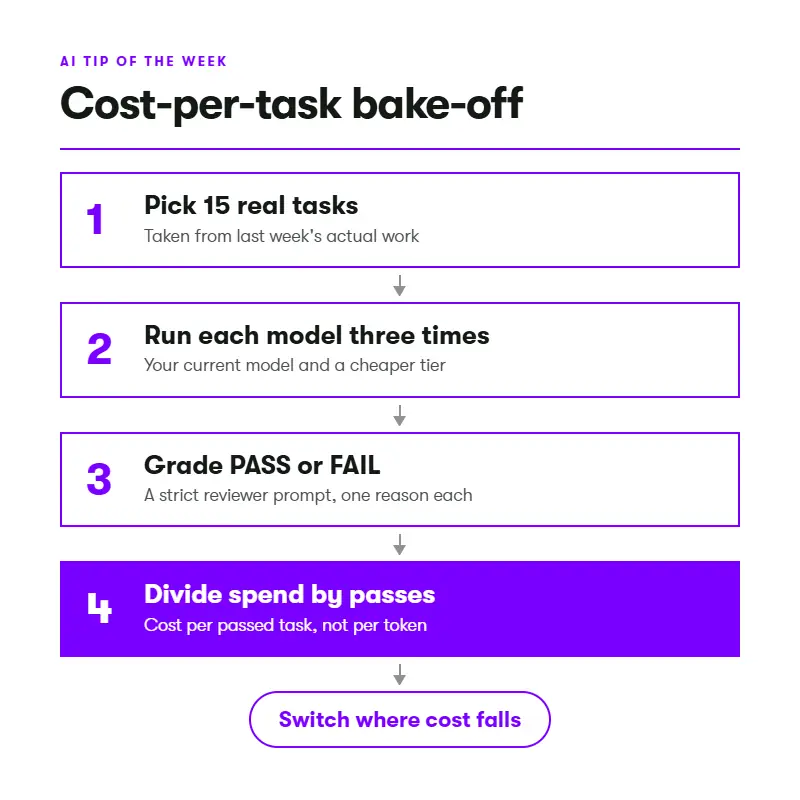
Run a cost-per-task bake-off before you switch models. 1) Pick 15 real tasks from last week's work. 2) Run each on your current model and a cheaper tier, three times. 3) Grade with this prompt: "You are a strict reviewer. Given the task, the reference answer and the output, reply PASS or FAIL with one reason." 4) Divide spend by passed tasks and switch only where that number falls.
The bottom line
The headline of the week was price. AI got cheap, and the advantage moved to teams that know which tasks need which model. Measure cost per finished task, keep your stack portable, and the next price cut becomes a margin gain for you, with no migration project attached.
Sources
Newsletters: The Batch, The Neuron, The Deep View, AI Valley, The AI Break, What's Up in AI, Neatprompts, Creator Secrets, Linas's Newsletter, Salazar's AI News.
- Anthropic: Claude Haiku 5.5
- eesel AI: Claude Haiku 5.5 pricing and the 100K step
- ProPakistani: GPT-6.1 Sol pricing versus Astra
- The Information: Meta and Microsoft work to wean staff off Claude
- The Deep View: How Meta Muse turns your relationships into data (on Wired's report)
- Apple Developer: Updates to Full Disk Access in macOS
- Newsweek: Utah launches first US AI prescription pilot
- Hotovo: AI-assisted frontend migration for Protecht