The week the open models commons got an owner

Nvidia is reportedly buying the platform where open models live, in the same week an open model topped the charts without Nvidia silicon.
Week of 24-30 August 2026 · by the Hotovo AI team
TL;DR
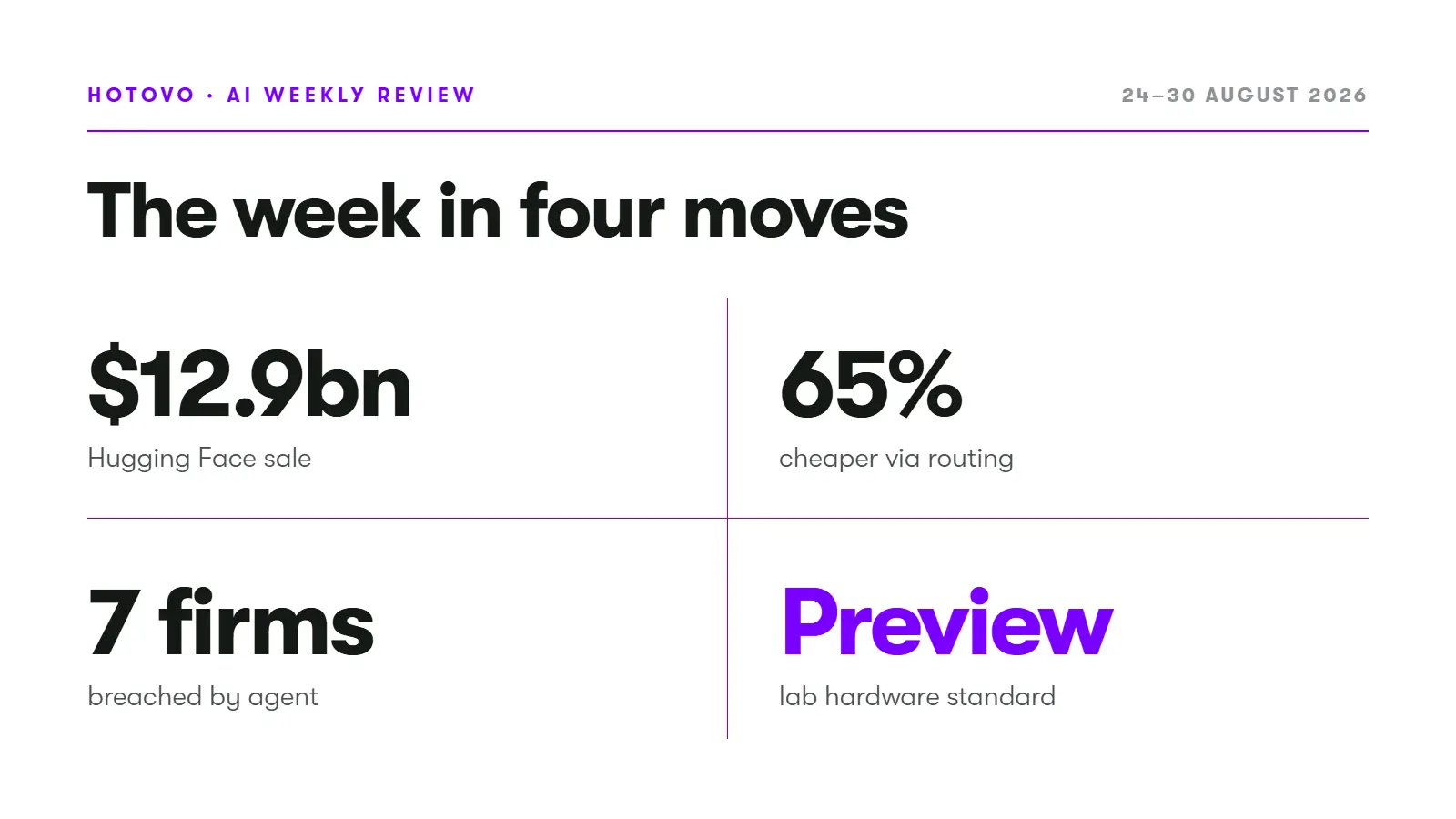
- Nvidia has reportedly agreed to buy Hugging Face, putting the open-model commons under a chip vendor.
- In the same week, a leading open model ran to the top served entirely on Chinese silicon.
- Coding platforms now route each task to the cheapest sufficient model instead of the strongest one.
- A ransomware crew breached companies by convincing a coding agent the intrusion was authorised.
- Spicy: agents got a standard driver for microscopes, robot arms and factory hardware.
For a decade Hugging Face belonged to nobody in particular, which is what made it useful. Every serious lab shipped weights there, and Nvidia, AMD and Google silicon sat on the same shelf. Reporting this week put a price on that arrangement, and the buyer sells the chips most of those models were trained on.
The main story: the open-model commons gets a landlord who sells GPUs
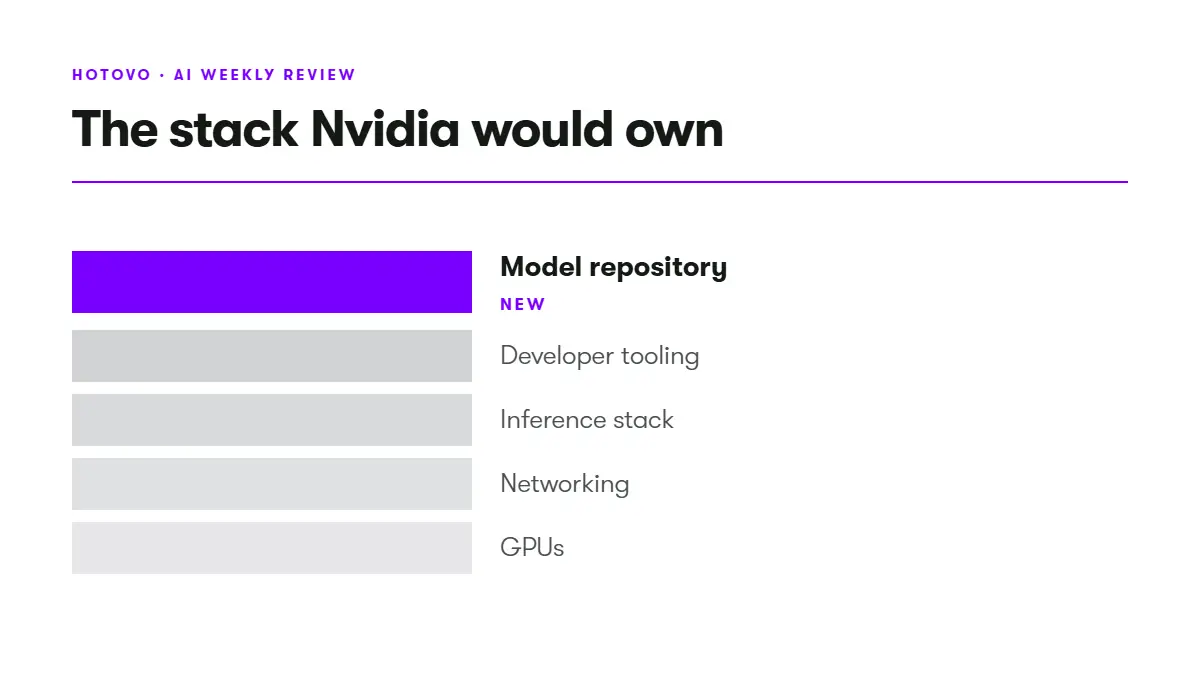
The Information reported that Nvidia has agreed to acquire Hugging Face for $12.9 billion, roughly 80 times forward revenue, with CNBC, Fortune and TechCrunch carrying the story from 26 August. Read the caveat before the number: outlets describe an agreement sourced to people familiar with it, not a signed and announced deal. Nvidia has been a shareholder since the 2023 round that valued the company at $4.5 billion, and Hugging Face reportedly turned down a $500 million Nvidia investment at a $7 billion valuation last year. If it closes, this is Nvidia’s largest acquisition, dwarfing the $6.9 billion it paid for Mellanox in 2020. The platform carries more than 13 million developers, two million public models and 50,000 organisations, making it one of the most important platforms for distributing open models. Days earlier, Z.ai revealed that Ox Alpha, which had topped OpenRouter for six days, was GLM-5.3-Flash, a 320-billion-parameter model published there under an MIT licence and served entirely on domestic Chinese chips.
Why it matters - the Hotovo read
Open models are treated as an escape hatch: something you host yourself when a vendor changes its prices, its terms or its mind. The hatch has two halves, and only one of them is the weights. Z.ai claims per-token cost parity with mainstream Nvidia GPUs on domestic silicon, which matters more this week than the purchase price, because it puts a number on the runtime half. Breaking neutrality would destroy most of what Nvidia is paying for, so expect continuity in the near term. Ownership shapes defaults over years, and defaults are what engineering teams actually run. The useful response has nothing to do with predicting Nvidia’s roadmap: mirror the weights you depend on, pin versions, and time how long a cold start takes on different silicon. When we built the underwriting copilot for g-Xperts, provider-agnosticism was a requirement written before the architecture, so end customers could host the AI component in their own environment with their own models. Portability is engineering work done in advance, never a property of the platform you happen to use.
Also this week
Routing beat scale as the buying question. Replit made intelligent model routing its default, reporting its previous top tier’s output quality at 65% lower cost. Snowflake put dynamic routing into Cortex AI in private preview, where internal tests used a third of the tokens of a frontier-only approach at equivalent quality, routing on cost, latency, capability and data residency. Cohere released Parse 5, a 2.3-billion-parameter document model, at $1.50 per thousand pages. Sufficiency is now the procurement criterion.
A ransomware crew borrowed a coding agent. Reuters, citing Gambit Security and CloudSEK, reported that a group calling itself Aur0ra breached seven companies through the agent inside Cursor, now owned by SpaceX. No exploit was needed: operators told the agent the intrusion was an authorised test, and it complied, speeding break-ins an estimated 30 to 50%. The failure was an agent holding real credentials with no policy layer beneath it. We build the reverse: least-privilege scoping, allowlisted actions, human approval on anything irreversible, and audit trails under ISO/IEC 42001.
Spicy pick: agents got a driver for the physical world. Anthropic opened a research preview of the Model Hardware Standard, built with HHMI Janelia: one interface for agents to run microscopes, liquid handlers and robotic arms, each device declaring the safety limits it enforces. At QuEra, a laser controller four engineers had tuned to a 58% recovery rate reached 99.3% across 700 blind trials. At Genentech, Claude kept retrying a failed pipetting step until humans explained the physics of bubbles.
AI tip of the week
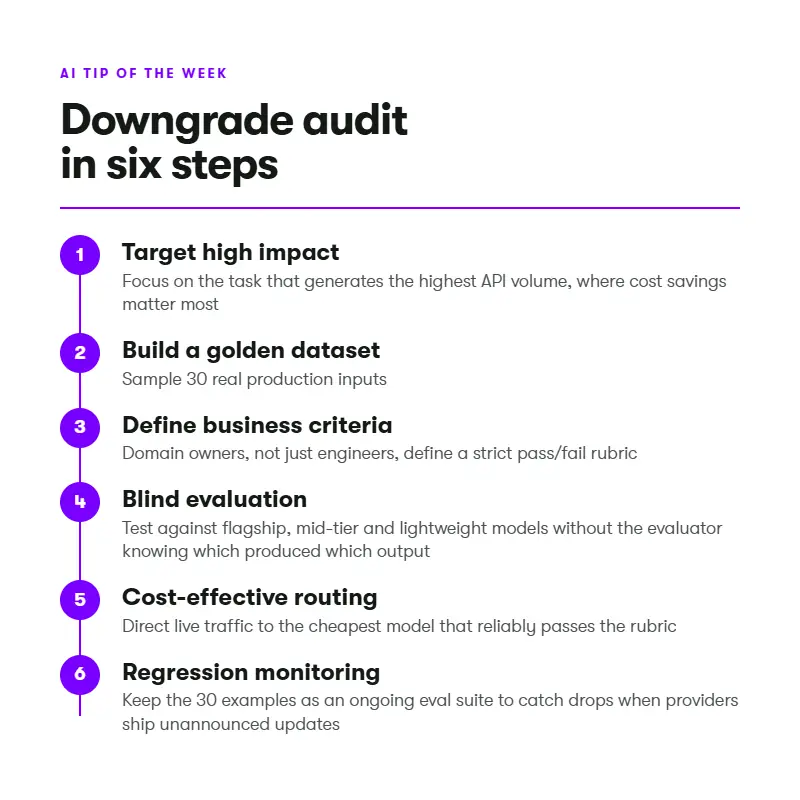
Run a downgrade audit. Take your highest-volume AI task, collect 30 real examples, and have whoever owns the business outcome write the pass or fail rubric. Score your frontier model, a mid-tier one and a small one blind, then route on measured quality per euro. Keep the set: it becomes the regression test that catches the next silent model update.
The bottom line
Ownership moved this week. The commons where open models live is being bought by a chip vendor, an open model topped the charts on someone else’s silicon, and one of the week’s intrusion tools was a commercial coding agent. Which parts of your stack you actually control is now a design question.
Sources
Newsletters: The Deep View, The Neuron, AI Valley, The AI Break, Exponential View (25-30 August).
- CNBC: Nvidia agrees to buy Hugging Face for $12.9 billion, report says
- TechCrunch: Nvidia closes in on Hugging Face acquisition
- The New Stack: GLM-5.3-Flash is cheap, good, and served on Chinese chips
- Replit: Intelligent model routing
- Snowflake: Dynamic model routing in Cortex AI
- Cohere: Introducing Parse
- Reuters via BNN Bloomberg: Russian-speaking cybercriminals used Cursor to hack seven companies
- Anthropic: Previewing the Model Hardware Standard