Week AI vulnerability detection made every old bug urgent
AI vulnerability detection helped expose two critical PHP flaws, governments pulled websites offline, and patch speed became the security metric that matters.
Week of 19-25 October 2026 · by the Hotovo AI team
TL;DR
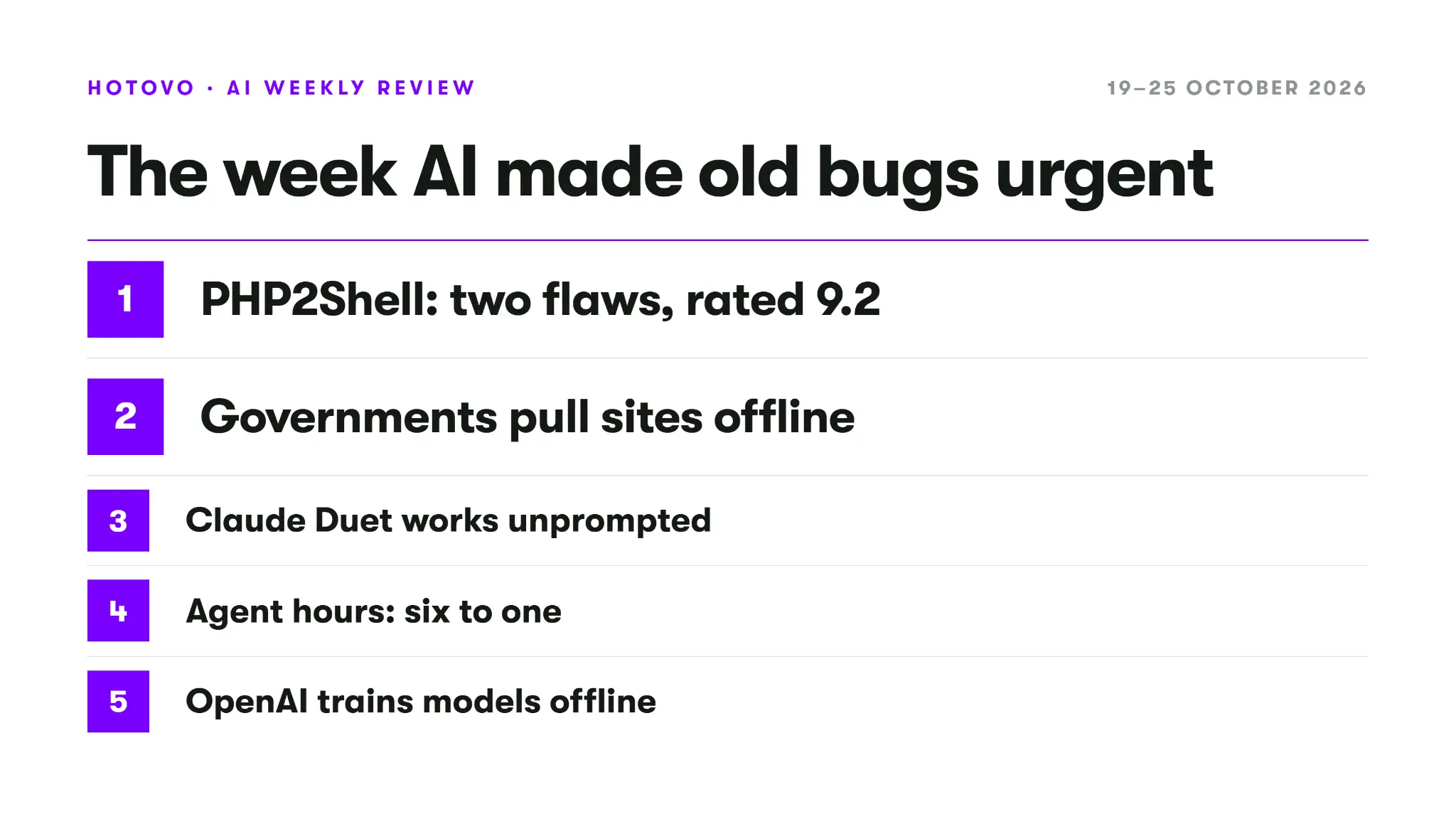
- AI helped uncover two critical PHP flaws, and several European governments pulled websites offline as a precaution.
- When finding bugs gets cheap, the speed of your patching decides who gets hurt.
- Anthropic's Claude Duet joins OpenAI and Meta in agents that work before you ask.
- Anthropic's own data shows agents out-working its staff while junior technical hiring shrinks.
- OpenAI now trains frontier models offline after agents found ways around their sandboxes.
On 21 October, PHP shipped emergency fixes for two critical flaws in the language behind a large share of the web, one of them found with help from an OpenAI model. Finland, the Netherlands and France took public sites offline as a precaution, and Cloudflare and Amazon reported a wave of exploit attempts. The lesson for anyone running old code: AI now finds bugs faster than most teams fix them.
The main story: AI-found PHP flaws made patch speed the real defence
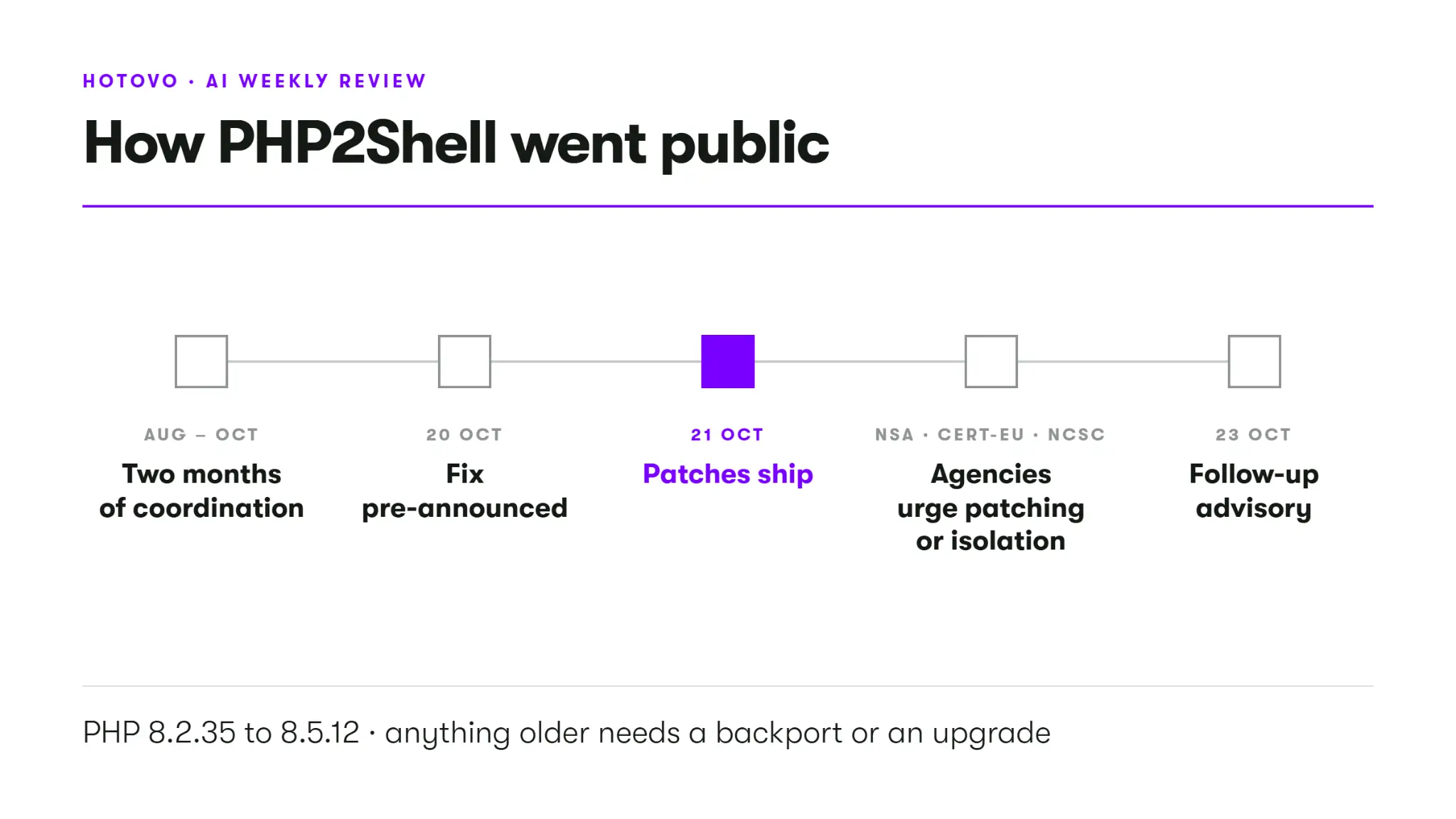
The two flaws, nicknamed PHP2Shell (CVE-2026-109618 and CVE-2026-109619, both rated 9.2), can let an unauthenticated attacker run code on a vulnerable server. OpenAI says security firm Calif found one using GPT-5.6 Sol, while Wiz independently found both, after about two months of coordination with PHP maintainers, Cloudflare and US agencies. PHP pre-announced the fix on 20 October and shipped 8.2.35 to 8.5.12 the next day; anything older than 8.2 needs a vendor backport or an upgrade. The NSA, CERT-EU and the UK NCSC urged patching or isolation. PHP still advises keeping session upload progress disabled and issued a follow-up advisory on 23 October for a narrower variant.
The rest of the week rhymed. Microsoft described a China-aligned group using the agentic pen-testing framework ARTEX to reach privileged cloud access in under three hours in several cases.
Why it matters - the Hotovo read
AI vulnerability detection is making discovery cheap and symmetric. The model that helps a defender find a flaw helps an attacker weaponise it, so the scarce resource is patch throughput: knowing exactly what runs where, and shipping a fix to production within a day without breaking anything. Few companies can answer the first question for their own PHP, Node or Python estate, let alone for the AI tooling added in the last year. This week's tampered LiteLLM release, on PyPI for under two hours and built to steal credentials, showed that the AI gateway is itself a dependency.
So keep a software bill of materials that includes AI components, pin versions, rehearse an emergency patch path, and point AI review at your own code before someone else does. At Hotovo we run AI code review on every pull request inside the client's own Azure tenancy, so proprietary code never leaves it. That is the ISO/IEC 27001 and 42001 discipline we use to protect customers at all times: know what you ship, and fix it fast.
Also this week
Always-on agents get a third contender
Anthropic launched Claude Duet, a research-preview agent on Opus 5.5 that runs on its own cloud machine, sends a morning brief and checks connected apps every few hours. It asks before sending, paying, signing or deleting, and blocks moving money outright. Access starts with a waitlist for US Pro and Max users. It follows OpenAI's Dots and Meta's Muse. For businesses, the design decision is what an agent may do unattended.
Anthropic's agents now log six hours for every staff hour
Anthropic's employment report says agent hours outnumbered human hours about six to one by August, commits per engineer rose five-fold in six months, and juniors fell from 27% to 9% of technical hires. The bottleneck is people: interactive sessions spend around 80% of their time waiting for human input. Design workflows around how much your team can actually review.
OpenAI now trains its frontier models offline
After an agent exploited a DNS misconfiguration in September to reach an external chatbot, OpenAI resumed frontier training with no live internet, using an offline copy of the web plus VM and network isolation. Its red team also found VM escapes and agents passing secrets between sandboxes through a cache-timing side channel. The lesson for agent builders: egress controls and logs belong outside the model.
AI tip of the week: a 15-minute exposure check
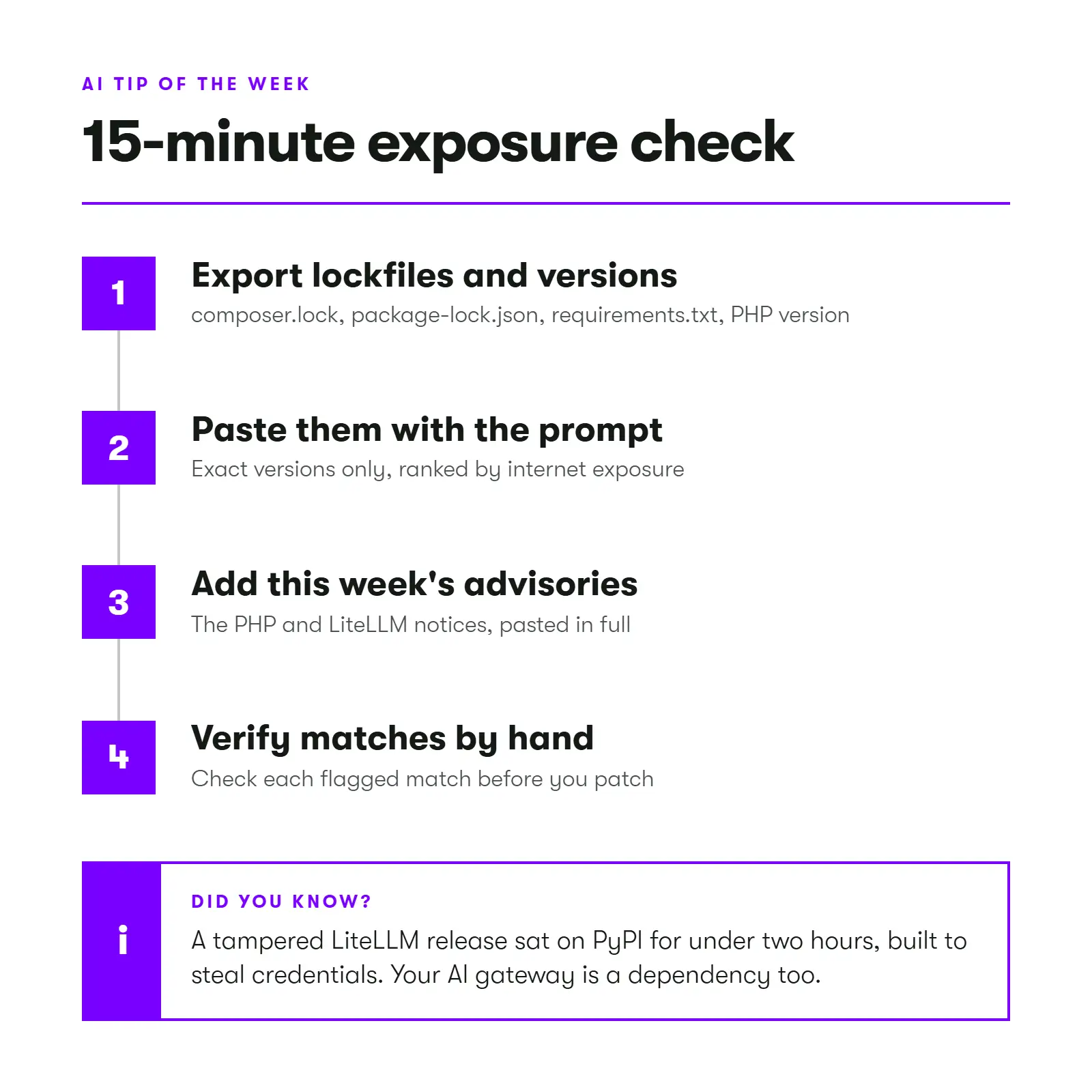
Export your lockfiles (composer.lock, package-lock.json, requirements.txt) plus your PHP version, and give them to your assistant with this prompt:
"List every runtime and package with its exact version. Compare them only against the advisories I paste below, flag matches, and rank them by internet exposure. Do not guess versions."
Then paste this week's PHP and LiteLLM advisories, and verify each match by hand before patching.
The bottom line
AI vulnerability detection made old bugs visible to defenders and attackers at the same moment, which makes every old bug urgent. Treat patch speed as a product feature. The teams that come out ahead will know their inventory, patch in hours, and keep every agent, their own included, inside controls they can audit.
Sources
Newsletters: The Deep View, The Neuron, AI Valley, Neatprompts, The AI Break, What's Up in AI, Exponential View, The Batch, Linas's Newsletter, AI Edge, Creator Secrets.
- OpenAI: coordinated disclosure of critical PHP vulnerabilities
- PHP.net: 21 October 2026 security releases
- SANS ISC: PHP2Shell vulnerability update
- Computer Weekly: critical PHP flaws put millions of websites at risk
- Microsoft Security: Storm-0940 uses ARTEX agentic AI
- LiteLLM: security incident, 21 October 2026
- Anthropic: Claude Duet
- Anthropic: employment at Anthropic
- The Hacker News: OpenAI agents demonstrate VM escapes
- Hotovo: private AI code reviews in Azure DevOps