Other industries
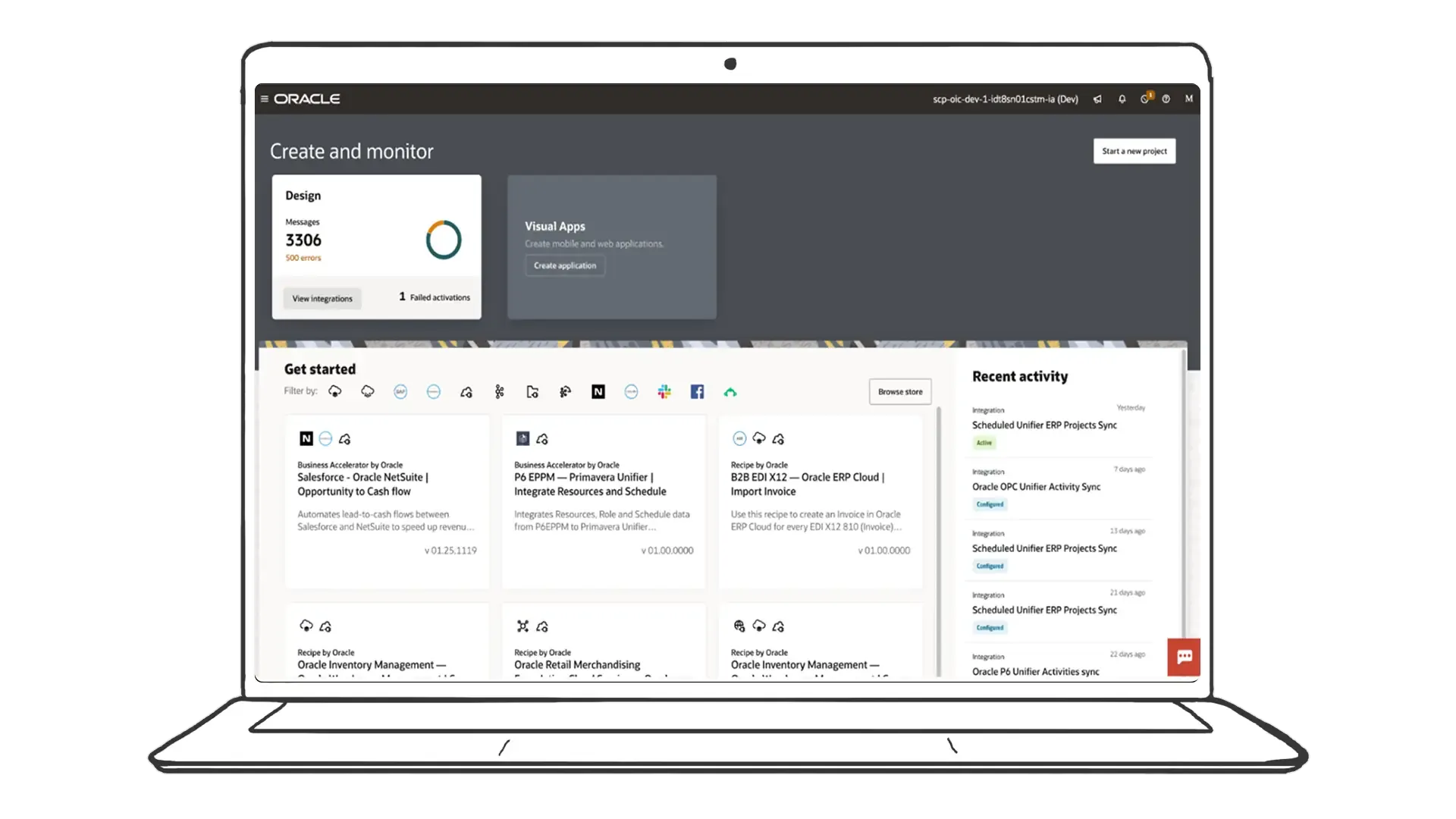
Oracle Integration Cloud recipes
Key achievements
“I’ve worked with many offshore teams, but none of them were as responsible as you.”
Praveen Morusupalli, Engineering Director - OIC
Client

Oracle is one of the world's largest enterprise software and cloud companies, offering databases, cloud infrastructure and business applications for ERP, CRM, HCM and project delivery. Hotovo was an Oracle integration partner for 8 years, building Oracle Integration Cloud (OIC) integrations that link Oracle and non-Oracle systems.
1x65vi1wv4rhohf5sklhb5l14bsm94-small.webp)
l0tnjmcbl3m2rc6vcr182ez0m7nk3t-small.webp)
f6xggq81ar5wcxpkcbqg6dpvbxn0ub-small.webp)
bgdwiiabgjqg2ix67txojfiv41kcsr-small.webp)
qrjbtbnbnlsxlht9kv2jfa3y765gmb-small.webp)
Case study
The need
Oracle needed ready-to-use integrations that enterprise customers could activate fast, often for go-live dates only weeks away.
Most enterprises run a mix of SaaS applications, and one business process often spans several of them. Typical examples are a CRM linked to an ERP, an e-commerce store feeding back-office operations, or separate tools for engineering, scheduling, project controls and documents. Each system has its own API style, data model and authentication, so building every integration from scratch is slow and expensive.
When Hotovo joined, Oracle already had its own integration platform, but it still had rough edges. Oracle was looking for a partner to:
- improve the platform through hands-on use and feedback
- build reusable integrations that cover end-to-end business processes
- provide rigorous testing of the created solutions
- work closely with Oracle's international product and development teams
Our solution
Hotovo built a portfolio of Oracle Integration Cloud recipes, accelerators and dedicated adapters. Customers activate them with minimal configuration instead of building integrations from scratch. The work grew in two phases: business application integrations first, then complex project and asset delivery.
Phase 1: platform feedback and Oracle Marketplace integrations
We started by using Oracle's integration platform every day and reporting bugs, improvements and usability ideas. Next, we built sample integrations for Oracle Marketplace. Then we moved on to ready-to-use solutions for end-to-end business processes:
- CRM to ERP: one process connecting Salesforce and Oracle NetSuite, with visibility into prospects, purchases, invoices, payments and other financial activity.
- E-commerce to ERP: a pre-built order-to-cash integration. It syncs customers, products, orders, fulfillments, invoices and payments, so online stores can hand back-office work to the ERP and focus on their customers.
- Customer service visibility: back-office data such as sales orders, support cases, time tracking and financials, shown directly in the support tool so agents resolve requests faster.
Our scope in this phase included:
- Implementation of new OIC integrations between Oracle and non-Oracle systems
- custom code that extends individual integrations
- converting legacy integrations to new standards
- setting up environments for integration with OIC
- creation of test data on both ends of each created integration
- testing new and updated integrations
- technical documentation and user manuals
- publishing recipes to Oracle Marketplace
We covered point-to-point, ETL, iSaaS and enterprise application integration, using migration and bi-directional synchronization patterns.
Phase 2: integration recipes for project delivery
An OIC recipe is a pre-built integration with ready-made business flows, field mappings, error handling and configurable parameters. For project and asset delivery, our recipes:
- Turn product deliverables into project activities. Approved deliverables and design items move from Oracle Fusion PLM into Oracle Primavera Cloud as structured work packages, with no manual re-entry.
- Connect agile delivery with project controls. Epics, phases and milestones from agile tools sync with activities in project management tools, and progress flows back into project and portfolio views.
- Make document transfers controlled and auditable. Documents move between Oracle Aconex and other project environments without re-uploads or outdated versions.
Project delivery accelerators
An accelerator is a larger, end-to-end bundle of integrations. Ours keep schedules, resources, costs and master data in sync between planning tools and project controls platforms: Oracle P6 EPPM, Oracle Primavera Cloud and Oracle Primavera Unifier. A second accelerator helps enterprises on legacy scheduling platforms move to harmonized activity sheets and progress tracking.
With the Oracle Primavera Unifier product team, we also added a one-click sync button inside Unifier. After a one-time setup, users sync project and schedule data without opening OIC.
Oracle Aconex adapter for OIC
An OIC adapter is a pre-built connector that hides a system's authentication, payload formats and endpoints. Integrators pick a module and an operation, and the adapter generates the technical setup.
We built and published a dedicated OIC adapter for Oracle Aconex, Oracle's construction collaboration platform. Aconex uses different JSON and XML APIs across its modules and has no central schema. Our adapter:
- guides users through choosing a module and an operation, then builds the request and handles the response
- normalizes the inconsistent APIs through one shared foundation layer
- handles documents, metadata and file uploads automatically, picking the right upload method for small and large files
Customers can now connect Aconex to their processes in a few clicks, without deep API knowledge or custom code.
How we solved the main challenges
- Tight go-live dates. We put reusable patterns first, ran joint design and validation sessions with Oracle, and delivered on time. One customer was starting a large construction project in the Amazon rainforest, where mobilization had to fit a narrow natural window. A delay could have pushed the start back by up to a year. We adapted our schedule sync accelerator to the customer's setup and worked directly with their development and QA teams, and the project started on schedule.
- Complex data mappings. We used JavaScript inside OIC for custom logic and advanced XSLT for transformations the graphical mapper can't handle, including XPath expressions, user-defined functions, grouping and aggregation. Everything stays aligned with OIC best practices.
- Fragmented external APIs. We packed each system's authentication, payloads and file handling into adapters and flows, so other teams integrate through simple, consistent interfaces.
- Rigorous testing. A solid integration has all edge cases covered. We created realistic test data on every platform that was integrated - from Salesforce, NetSuite to Oracle Primavera.
Key results
Hotovo's OIC recipes, accelerators and adapters cut integration build time for Oracle customers from weeks to hours or days.
- Reusable patterns: customers reuse proven integrations across regions and business units instead of starting from zero.
- Fewer manual steps and errors: automated flows replace manual handoffs in order-to-cash, CRM-to-ERP, design release, scheduling, cost control and document management.
- Consistent data across systems: schedules, costs, orders, invoices and documents stay in sync across Oracle and non-Oracle applications.
- On-time go-lives: including a construction project in the Amazon rainforest that started on schedule within a narrow natural window.
- Lower OIC running costs: OIC charges per message, so we kept payloads small, cut API calls with batching, filtering and reuse of intermediate results, and tuned file transfers. Syncs run faster as a result.
- Simpler for business and IT teams: sync buttons inside business apps, guided setup in OIC, and standard logging and error handling that operations teams can act on quickly.
- Available on Oracle Marketplace: our integration recipes and the Oracle Aconex adapter are published for Oracle customers worldwide.
The result is an integration layer that feels like part of the Oracle product, not a separate system to manage.
Tech stack
Hotovo built every integration on Oracle Integration Cloud and connected it with these Oracle and third-party systems.
n2apulif97gje906mf8odesrpfupi9.webp)
Team size
Hotovo's current Oracle team is two developers, working with a seven-person Oracle team.
Hotovo (business-application phase):
- Project Manager
- Technical Lead
- Software Developer
- Manual Tester
- Technical Writer/QA
Hotovo (later project phase):
- 2 Software Developers
Oracle: Director of Software Development, Enterprise Architect, Principal Member of Technical Staff, 4 developers, working with Oracle's international product teams (including Oracle Primavera Unifier)